
 |
 |
 |
 |
 |
 |
 |
 |
 |
 |

| . |  |
. |
Astronomers Discover Most Dark Matter-Dominated Galaxy In Universe
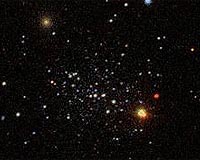
New Haven CT (SPX) Sep 22, 2008 A team led by a Yale University astronomer has discovered the least luminous, most dark matter-filled galaxy known to exist. The galaxy, called Segue 1, is one of about two dozen small satellite galaxies orbiting our own Milky Way galaxy. The ultra-faint galaxy is a billion times less bright than the Milky Way, according to the team's results, to be published in an upcoming issue of The Astrophysical Journal (ApJ). But despite its small number of visible stars, Segue 1 is nearly a thousand times more massive than it appears, meaning most of its mass must come from dark matter. "I'm excited about this object," said Marla Geha, an assistant professor of astronomy at Yale and the paper's lead author. "Segue 1 is the most extreme example of a galaxy that contains only a few hundred stars, yet has a relatively large mass." Geha, along with her colleague Josh Simon at the California Institute of Technology, has observed about half of the dwarf satellite galaxies that orbit the Milky Way. These objects are so faint and contain so few stars that at first they were thought to be globular clusters - tightly bound star clusters that also orbit our host galaxy. But by analyzing the light coming from the objects using the Keck telescope in Hawaii, Geha and Simon showed that these objects are actually galaxies themselves, albeit very dim ones. Looking only at the light emitted by these ultra-faint galaxies, Geha and her colleagues expected them to have correspondingly low masses. Instead, they discovered that they are between 100 and 1000 times more massive than they appear. Invisible dark matter, she said, must account for the difference. Although dark matter doesn't emit or absorb light, scientists can measure its gravitational effect on ordinary matter and believe it makes up about 85 percent of the total mass in the universe. Finding ultra-faint galaxies like Segue 1, which is so rife with dark matter, provides clues as to how galaxies form and evolve, especially at the smallest scales. "These dwarf galaxies tell us a great deal about galaxy formation," Geha said. "For example, different theories about how galaxies form predict different numbers of dwarf galaxies versus large galaxies. So just comparing numbers is significant." It's only recently that astronomers have discovered just how prevalent these dwarf satellite galaxies are, thanks to projects like the Sloan Digital Sky Survey, which imaged large areas of the nighttime sky in greater detail than ever before. In the past two years alone, the number of known dwarf galaxies orbiting the Milky Way has doubled from the dozen or so brightest that were discovered during the first half of the twentieth century. Geha predicts astronomers will find even more as they continue to sift through new data. "The galaxies I now consider bright used to be the least luminous ones we knew about," she said. "It's a totally new regime. This is a story that's just unfolding." The authors of the paper are Marla Geha (Yale University), Beth Willman (Harvard-Smithsonian Center for Astrophysics), Joshua D. Simon (California Institute of Technology), Louis E. Strigari (University of California, Irvine), Evan N. Kirby (University of California, Santa Cruz and Lick Observatory), David R. Law (California Institute of Technology) and Jay Strader (Harvard-Smithsonian Center for Astrophysics). Community Email This Article Comment On This Article Share This Article With Planet Earth
Related Links Yale University Stellar Chemistry, The Universe And All Within It
 BOSS: The Baryon Oscillation Spectroscopic Survey
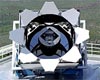 Apache Point NM (SPX) Sep 19, 2008
The Sloan Digital Sky Survey (SDSS) uses a 2.5-meter telescope with a wider field of view than any other large telescope, located on a mountaintop in New Mexico called Apache Point and devoted solely to mapping the universe. |
|
|

| The content herein, unless otherwise known to be public domain, are Copyright 1995-2007 - SpaceDaily.AFP and UPI Wire Stories are copyright Agence France-Presse and United Press International. ESA Portal Reports are copyright European Space Agency. All NASA sourced material is public domain. Additional copyrights may apply in whole or part to other bona fide parties. Advertising does not imply endorsement,agreement or approval of any opinions, statements or information provided by SpaceDaily on any Web page published or hosted by SpaceDaily. Privacy Statement |
 del.icio.us
 Digg
Digg Reddit
 YahooMyWeb
 Google
 Facebook