|
 |
 |
 |
 |
 |
 |
 |
 |
 |

| . |  |
. |
Astronomers See Inside A Quasar For The First Time
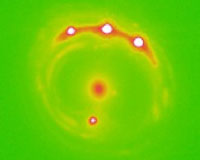
Columbus OH (SPX) Oct 09, 2006 For the first time, astronomers have looked inside quasars -- the brightest objects in the universe -- and have seen evidence of black holes. The study lends further confirmation to what scientists have long suspected -- that quasars are made up of super-massive black holes and the super-heated disks of material that are spiraling into them. The results of the Ohio State University-led project were reported Thursday at the meeting of the American Astronomical Society (AAS) High Energy Astrophysics Division in San Francisco. "There are many models that try to describe what's happening inside a quasar, and before, none of them could be ruled out. Now some of them can," said Xinyu Dai, a postdoctoral researcher at Ohio State. "We can begin to make more precise models of quasars, and gain a more complete view of black holes." Seen from Earth, quasars, or quasi-stellar objects, look like stars. They are extremely bright, which is why we can see them even though they are among the most distant objects in the universe. Astronomers puzzled over quasars for decades before deciding that they most likely contain super-massive black holes that formed billions of years ago. Black holes cannot be directly observed, because they are so massive that even light cannot escape their gravity. The material that is falling into a black hole, on the other hand, glows brightly. In the case of quasars, the material shines across a broad range of energies, including visible light, radio waves, and X-rays. Dai and Christopher Kochanek, professor of astronomy, and their colleagues studied the light emanating from two quasars. Quasars are so far away that even in the most advanced telescopes, they look like a tiny pinpoint of light. The interior structures of the two quasars in this study only became visible when a galaxy happened to line up just right between them and the Earth, and magnified their light like a lens. The astronomers likened the effect to being able to look at the quasars under a microscope. Einstein predicted that massive objects in space can sometimes act like lenses, bending and magnifying light from objects that are behind them, as seen by an observer. The effect is called gravitational lensing, and it enables astronomers to study some objects in otherwise unattainable detail. "Luckily for us, sometimes stars and galaxies act as very high-resolution telescopes," Kochanek said. "Now we're not just looking at a quasar, we're probing the very inside of a quasar and getting down to where the black hole is." They were able to measure the size of the so-called accretion disk around the black hole inside each quasar. In each, the disk surrounded a smaller area that was emitting X-rays, as if the disk material was being heated up as it fell into the black hole in the center. That's what they expected to see, given current notions about quasars. But the inside view will help them begin to refine those notions, Dai said. Key to the project was NASA's Chandra X-Ray Observatory, which allowed them to precisely measure the brightness of the X-ray emitting region of each quasar. They coupled those measurements to ones from optical telescopes which belong to the Small and Moderate Aperture Research Telescope System Consortium. The astronomers studied the variability of both the X-rays and visible light coming from the quasars and compared those measurements to calculate the size of the accretion disk in each. They used a computer program that Kochanek created especially for such calculations, and ran it on a 48-processor computer cluster. Calculations for each quasar took about a week to complete. The two quasars they studied are named RXJ1131-1231 and Q2237+0305, and there's nothing special about them, Kochanek said, except that they were both gravitationally lensed. He and his group are currently studying 20 such lensed quasars, and they'd like to eventually gather X-ray data on all of them. This project is part of an ongoing collaboration between Ohio State and Penn State University. Coauthors on the AAS presentation included Nicholas Morgan of Ohio State, and George Chartas and Gordon Garmire of Penn State. NASA funded this research. The computer cluster was provided by Cluster Ohio, an initiative of the Ohio Supercomputer Center (OSC), the Ohio Board of Regents, and the OSC Statewide Users Group. Related Links Ohio State University Stellar Chemistry, The Universe And All Within It  Exploding Stars Influence Climate Of Earth
 Copenhagen, Denmark (SPX) Oct 06, 2006
A team at the Danish National Space Center has discovered how cosmic rays from exploding stars can help to make clouds in the atmosphere. The results support the theory that cosmic rays influence Earth's climate. |
|
|

| The content herein, unless otherwise known to be public domain, are Copyright 1995-2006 - SpaceDaily.AFP and UPI Wire Stories are copyright Agence France-Presse and United Press International. ESA PortalReports are copyright European Space Agency. All NASA sourced material is public domain. Additionalcopyrights may apply in whole or part to other bona fide parties. Advertising does not imply endorsement,agreement or approval of any opinions, statements or information provided by SpaceDaily on any Web page published or hosted by SpaceDaily. Privacy Statement |