
 |
 |
 |
 |
 |
 |
 |
 |
 |
 |

| . |  |
. |
Beta Pictoris Planet Finally Imaged
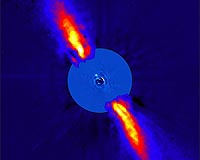
Paris, France (SPX) Nov 24, 2008 A team of French astronomers using ESO's Very Large Telescope have discovered an object located very close to the star Beta Pictoris, and which apparently lies inside its disc. With a projected distance from the star of only 8 times the Earth-Sun distance, this object is most likely the giant planet suspected from the peculiar shape of the disc and the previously observed infall of comets onto the star. It would then be the first image of a planet that is as close to its host star as Saturn is to the Sun. The hot star Beta Pictoris is one of the best-known examples of stars surrounded by a dusty 'debris' disc. Debris discs are composed of dust resulting from collisions among larger bodies like planetary embryos or asteroids. They are a bigger version of the zodiacal dust in our Solar System. Its disc was the first to be imaged - as early as 1984 - and remains the best-studied system. Earlier observations showed a warp of the disc, a secondary inclined disc and infalling comets onto the star. "These are indirect, but tell-tale signs that strongly suggest the presence of a massive planet lying between 5 and 10 times the mean Earth-Sun distance from its host star," says team leader Anne-Marie Lagrange. "However, probing the very inner region of the disc, so close to the glowing star, is a most challenging task." In 2003, the French team used the NAOS-CONICA instrument (or NACO [1]), mounted on one of the 8.2 m Unit Telescopes of ESO's Very Large Telescope (VLT), to benefit from both the high image quality provided by the Adaptive Optics system at infrared wavelengths and the good dynamics offered by the detector, in order to study the immediate surroundings of Beta Pictoris. Recently, a member of the team re-analysed the data in a different way to seek the trace of a companion to the star. Infrared wavelengths are indeed very well suited for such searches. "For this, the real challenge is to identify and subtract as accurately as possible the bright stellar halo," explains Lagrange. "We were able to achieve this after a precise and drastic selection of the best images recorded during our observations." The strategy proved very rewarding, as the astronomers were able to discern a feeble, point-like glow well inside the star's halo. To eliminate the possibility that this was an artefact and not a real object, a battery of tests was conducted and several members of the team, using three different methods, did the analysis independently, always with the same success. Moreover, the companion was also discovered in other data sets, further strengthening the team's conclusion: the companion is real. "Our observations point to the presence of a giant planet, about 8 times as massive as Jupiter and with a projected distance from its star of about 8 times the Earth-Sun distance, which is about the distance of Saturn in our Solar System [2]," says Lagrange. "We cannot yet rule out definitively, however, that the candidate companion could be a foreground or background object," cautions co-worker Gael Chauvin. "To eliminate this very small possibility, we will need to make new observations that confirm the nature of the discovery." The team also dug into the archives of the Hubble Space Telescope but couldn't see anything, "while most possible foreground or background objects would have been detected", remarks another team member, David Ehrenreich. The fact that the candidate companion lies in the plane of the disc also strongly implies that it is bound to the star and its proto-planetary disc. "Moreover, the candidate companion has exactly the mass and distance from its host star needed to explain all the disc's properties. This is clearly another nail in the coffin of the false alarm hypothesis," adds Lagrange. When confirmed, this candidate companion will be the closest planet from its star ever imaged. In particular, it will be located well inside the orbits of the outer planets of the Solar System. Several other planetary candidates have indeed been imaged, but they are all located further away from their host star: if located in the Solar System, they would lie close or beyond the orbit of the farthest planet, Neptune. The formation processes of these distant planets are likely to be quite different from those in our Solar System and in Beta Pictoris. "Direct imaging of extrasolar planets is necessary to test the various models of formation and evolution of planetary systems. But such observations are only beginning. Limited today to giant planets around young stars, they will in the future extend to the detection of cooler and older planets, with the forthcoming instruments on the VLT and on the next generation of optical telescopes," concludes team member Daniel Rouan. Only 12 million years old, the 'baby star' Beta Pictoris is located about 70 light-years away towards the constellation Pictor (the Painter). Share This Article With Planet Earth
Related Links ESO Lands Beyond Beyond - extra solar planets - news and science Life Beyond Earth
 New Planet Orbiting Dangerously Close To Giant Star
 University Park PA (SPX) Nov 20, 2008
A team of astronomers from Penn State and Nicolaus Copernicus University in Poland has discovered a new planet that is closely orbiting a red-giant star, HD 102272, which is much more evolved than our own Sun. The planet has a mass that is nearly six times that of Jupiter, the largest planet in our solar system. |
|
|

| The content herein, unless otherwise known to be public domain, are Copyright 1995-2007 - SpaceDaily.AFP and UPI Wire Stories are copyright Agence France-Presse and United Press International. ESA Portal Reports are copyright European Space Agency. All NASA sourced material is public domain. Additional copyrights may apply in whole or part to other bona fide parties. Advertising does not imply endorsement,agreement or approval of any opinions, statements or information provided by SpaceDaily on any Web page published or hosted by SpaceDaily. Privacy Statement |
 del.icio.us
 Digg
Digg Reddit
 YahooMyWeb
 Google
 Facebook