|
 |
 |
 |
 |
 |
 |
 |
 |
 |

| . |  |
. |
Blowing A Hole In A Comet: Take 2
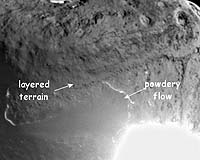
for NASA Science News Huntsville AL (SPX) Sep 27, 2007 The flash! The dazzle! The front page of the New York Times! Two years ago, NASA's Deep Impact spacecraft dropped an 820 lb copper projectile onto Comet Tempel 1, unleashing an explosion that made headlines around the world. Exploding comets tend to have that effect. But how many people know what happened after the blast? The surprising answer is none--not even NASA. Deep Impact's prime mission was to punch a hole in Tempel 1 and look inside, giving researchers their first glimpse of a comet's internal structure. But "we were never able to see the crater because the cloud of debris was so thick," says Michael New of NASA Headquarters. Why didn't Deep Impact wait until the dust cleared? It couldn't. The mission was designed from the beginning as a high-speed flyby, giving extra velocity to the "bullet." Orbiting was not an option. Carried by its own momentum, Deep Impact sailed away before the cloud had time to dissipate. Take 2: NASA is going back for a second look. "We're sending another spacecraft back to Tempel 1, the Stardust probe," says New. Stardust is famous for its January 2004 flyby of Comet Wild 2. Severely buffeted by jets of gas and debris flowing from the comet, Stardust nevertheless managed to snatch thousands of samples of comet dust and return them to Earth for analysis. "Stardust is one of the great successes of NASA's Discovery program," says New. (The Discovery program launches innovative, inexpensive spacecraft every 18-to-24 months on cutting edge missions. Deep Impact is also part of this program.) At first, Stardust was simply retired, sailing the void with nothing to dobut now it is being recycled as "Stardust-NExT," short for New Exploration of Tempel 1. Planetary science professor Joe Veverka of Cornell University is the mission's principal investigator. "We're very excited to go back," says Veverka. "Stardust is due to reach Comet Tempel 1 in 2011. By then the debris cloud will be long gone and we should get a clear view of the crater." Peering into the crater, however, "is only half the story," says Veverka. Before the cloud spoiled the view, Deep Impact's cameras recorded some surprising things. For one, the comet is ringed by a strangely-layered "sedimentary" terrain. There are no rivers on comets, so what causes these features? "Good question," says Veverka. One possibility: comets might be formed in layers. "Imagine two small proto-comets smashing into one another, sticking together and flattening like pieces of playdough," he says. Or maybe the layers are created via some form of hot erosion when the comet swings past the sun every 6.5 years. "We just don't know." Stardust will gather important clues. "We're returning to the comet almost exactly one orbit--that is, one comet-year--after the first visit. This gives us a chance to see how solar heating might have altered Tempel 1's face." Another surprise was landslides. "Deep Impact saw an enormous flow of smooth, powdery material" completely covering about a kilometer of underlying terrain, says Veverka. This feature is as mysterious as the layers, but it could explain one thing: why Deep Impact's debris cloud was so troublesome. "We might have hit a patch of deep powder," adds New. "Fine particles tend to make big clouds that are hard to see through." "This is why we explore," adds Veverka. "Tempel 1 is an amazing comet." Veverka notes that recycling a mission like Stardust is cheaper than sending a whole new spacecraft. "Stardust-NExT costs less than 15% of a full-up Discovery mission." "Giving new assignments to veteran spacecraft represents not only creative thinking and planning, but also a prime example of getting more from the budget we have," agrees Alan Stern, associate administrator of NASA's Science Mission Directorate. Deep Impact is being recycled, too. "We're using Deep Impact for two new projects," explains New. One is called DIXI (Deep Impact Extended Investigation): "Deep Impact will fly by Comet Boethin in December 2008 for a close-up investigation of the comet's nucleus." The second is EPOCh (Extrasolar Planet Observation and Characterization): "Cameras on Deep Impact will target nearby stars with known giant planets. By watching these planets transit (pass in front of) their stars, Deep Impact will be able to determine whether they possess rings and/or moons." For this work, EPOCh's sensitivity will exceed that of existing ground and space-based observatories, possibly leading to the discovery of new Earth-sized planets. No crater? No problem. Says New: "You can't keep a good Discovery mission down." Community Email This Article Comment On This Article Related Links Deep Impact Asteroid and Comet Mission News, Science and Technology
 Lumpy, Bumpy, Fluffy And Layered
 Paris, France (ESA) Sep 12, 2007
Observational and theoretical studies of Comet 67P/Churyumov-Gerasimenko, the target of ESA's Rosetta mission, are building a detailed portrait of the comet's nucleus as it travels around the Sun. Observations of the comet using the 8.2 m-ESO Very Large Telescope (VLT) show an irregularly-shaped object that is about 4.6 kilometres in diameter with a rotational period of 12 hours 49 minutes. |
|
|

| The content herein, unless otherwise known to be public domain, are Copyright 1995-2006 - SpaceDaily.AFP and UPI Wire Stories are copyright Agence France-Presse and United Press International. ESA PortalReports are copyright European Space Agency. All NASA sourced material is public domain. Additionalcopyrights may apply in whole or part to other bona fide parties. Advertising does not imply endorsement,agreement or approval of any opinions, statements or information provided by SpaceDaily on any Web page published or hosted by SpaceDaily. Privacy Statement |