|
 |
 |
 |
 |
 |
 |
 |
 |
 |

| . |  |
. |
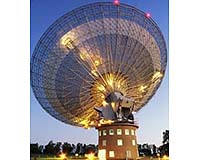
CSIRO Astronomers To Join Private Data Highway Across USA
Canberra, Australia (SPX) Apr 24, 2008 The link will allow the ATNF and collaborating institutions to show that large data sets can be moved, in real time, to and from Australia and around the globe. "This will be important for demonstrating techniques that will be used for the international Square Kilometre Array radio telescope," said Professor Brian Boyle, Director of CSIRO's Australia Telescope National Facility. The award is the first IDEA (Internet2 Driving Exemplary Applications) Wave of the Future Award from the Internet2 consortium, which represents more than 300 US universities, companies and government research institutions. The award is sponsored by Level 3 Communications, an international communications company headquartered in Colorado. It was presented at the Internet2 Spring Members' Meeting held in Arlington, Virginia. In the first instance, CSIRO's astronomers will use the link to work with colleagues at the Haystack Observatory run by MIT (Massachusetts Institute of Technology). Astronomers at both institutions are pioneering the use of data networks to link widely separated radio telescopes in real time. "By providing this circuit for this innovative application, we hope to support greater global collaboration and investments in radio astronomy research, and encourage innovative thinking about how new optical networking technology enables science and engineering," said Jack Suess, CIO of the University of Maryland, Baltimore County, and vice-chair of the Internet2 Applications, Middleware and Services Advisory Council. The technique the astronomers are working on is called e-VLBI (electronic very long baseline interferometry). In this, telescopes hundreds or thousands of kilometres apart observe the same region of sky simultaneously. Data from each telescope are sampled and sent to a super-computer via high-speed networks. The super-computer decodes and correlates the data and generates very high-resolution images of the cosmic objects being observed. "Currently, in a 12-hour VLBI experiment, each telescope used generates about 5500 gigabytes of data, which is the equivalent of 8500 CDs," explains Dr Tasso Tzioumis, Coordinator of VLBI Operations and Development at the Australia Telescope National Facility. "And in the next few years we expect to have even faster data rates." A typical VLBI experiment in Australia involves five or six telescopes, while an international experiment could use up to 20. E-VLBI has eliminated the weeks or even months it used to take to record and ship this data around on disks. It also allows astronomers to get instant feedback during observations, which will open up the study of quickly evolving, transient phenomena in the Universe. "We've made enormous progress since our first e-VLBI tests in 2006, but we're not yet able to just set up these experiments and press the 'go' button," said Dr Shaun Amy, Data Transmission Specialist for CSIRO's Australia Telescope National Facility, who accepted the Internet2 award for CSIRO. "This dedicated circuit will let us work out how to make these systems operate routinely. And what we discover about overcoming roadblocks to high data throughput will help researchers in other fields of science." The Internet2-sponsored link across the USA will be made available for a year. The data link from Sydney to Los Angeles will be provided by the Australian Academic and Research Network, AARNet. Community Email This Article Comment On This Article Related Links CSIRO Space Telescope News and Technology at Skynightly.com
 Powerful Antenna Attached To NASA's GLAST Satellite
 Greenbelt MD (SPX) Apr 22, 2008
The powerful antenna system that will enable NASA's Gamma-ray Large Area Telescope (GLAST) to communicate with stations on Earth has been successfully connected to the spacecraft in the Astrotech payload processing facility near NASA's Kennedy Space Center, Fla. |
|
|

| The content herein, unless otherwise known to be public domain, are Copyright 1995-2007 - SpaceDaily.AFP and UPI Wire Stories are copyright Agence France-Presse and United Press International. ESA Portal Reports are copyright European Space Agency. All NASA sourced material is public domain. Additional copyrights may apply in whole or part to other bona fide parties. Advertising does not imply endorsement,agreement or approval of any opinions, statements or information provided by SpaceDaily on any Web page published or hosted by SpaceDaily. Privacy Statement |