|
 |
 |
 |
 |
 |
 |
 |
 |
 |

| . |  |
. |
Cambridge Astronomers Take Hubble-Quality Images from the Ground
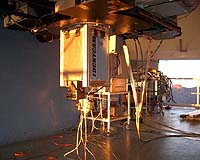
Cambridge UK (SPX) Nov 02, 2004 University of Cambridge Astronomers have developed a new method for taking images of the universe from the ground that are almost free of atmospheric distortions. Using a Charge-Coupled Device detector that has no readout noise, they developed a new camera that takes pictures of the sky at very high speed. The best pictures are selected and combined to give the final picture. Developed by Dr Craig Mackay and his team at the University of Cambridge Institute of Astronomy and Professor John Baldwin at Cavendish Laboratory, this new technique allows for high resolution imaging from the ground for the first time, something that will allow astronomers to tackle mapping of the invisible dark matter in the universe. Dr Mackay said that by understanding this mass distribution properly, astronomers can now hope to understand how the universe evolved from its original hot big bang to where it is now. Ground-based astronomy is limited by the way atmospheric turbulence smears images, which limits our view of the universe form the ground. This is, in fact, one of the main reasons for going into space. "This new camera and the image selection method we call 'Lucky Imaging' will revolutionise astronomical image quality obtainable from the ground. There are currently many observing programmes that need to cover wide areas of the sky, something the Hubble Space Telescope cannot do. This method will now allow wide field imaging with a level of quality only achievable with the Hubble Space Telescope," said Dr Mackay. The new technique, however, will not replace the Hubble Space technology. It will simply allow high-quality pictures to be taken from the ground over large areas of the sky, something present instruments are unable to do. "This will allow us to measure the way images of distant galaxies are distorted by invisible dark matter, something of great importance for cosmology. This is the first time we may have a technique that will allow the tracing of dark matter throughout the universe to be tackled properly," said Dr Mackay. Dr Mackay's team are planning to build a much larger camera that will cover areas of the sky quickly and efficiently. Related Links Institute of Astronomy University of Cambridge SpaceDaily Search SpaceDaily Subscribe To SpaceDaily Express  Keck Interferometer team to make stars 'Disappear'
 Pasadena (JPL) Oct 22, 2004
The technological magicians at NASA's Jet Propulsion Laboratory and the W.M. Keck Observatory are a step closer to performing a vanishing act on a cosmic scale. |
|
|

| The content herein, unless otherwise known to be public domain, are Copyright 1995-2006 - SpaceDaily.AFP and UPI Wire Stories are copyright Agence France-Presse and United Press International. ESA PortalReports are copyright European Space Agency. All NASA sourced material is public domain. Additionalcopyrights may apply in whole or part to other bona fide parties. Advertising does not imply endorsement,agreement or approval of any opinions, statements or information provided by SpaceDaily on any Web page published or hosted by SpaceDaily. Privacy Statement |