|
 |
 |
 |
 |
 |
 |
 |
 |
 |

| . |  |
. |
Keck Interferometer team to make stars 'Disappear'
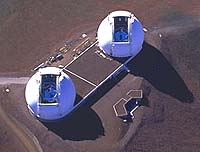
Pasadena (JPL) Oct 22, 2004 The technological magicians at NASA's Jet Propulsion Laboratory and the W.M. Keck Observatory are a step closer to performing a vanishing act on a cosmic scale. With an instrument recently installed as part of the Keck Interferometer, they can make stars disappear almost completely from a telescope's view and reveal the close-in regions where planets may have formed. This fall, astronomers will continue integration and test of the instrument, called the "Nuller," which will contribute to NASA's search for planets around other stars. "We have successfully combined infrared light from both 10-meter (33-foot) Keck telescopes using the new Nuller instrument," said Dr. Jim Fanson, Keck Interferometer project manager at JPL. "This permits a so-called 'visibility' measurement, where we can measure the size of objects with exquisite precision. "Later this year, when we complete our functional tests of the Nuller, we'll be ready to attempt our first null measurement," Fanson said. The Keck Interferometer is a NASA project that combines light from the world's largest optical telescopes to create a new type of telescope with unprecedented power. An interferometer is a device that gathers light waves from multiple telescopes, and then combines the waves in such a way that they interact, or "interfere" with each other. Depending on how the light waves are combined, they can combine constructively, creating higher intensity, or they can combine destructively, creating lower intensity. The resulting light pattern, called an "interference fringe," can be decoded by astronomers to make high precision measurements, such as a star's diameter or the size of an accretion disk around a black hole. The Nulling instrument is designed to combine the starlight waves destructively, so they cancel each other out. With the starlight glare suppressed, the faint light from dust orbiting around the star can be detected. "You're getting rid of this great big searchlight that the star is, and you're seeing the faint stuff orbiting nearby that you normally can't see because of the glare," said Dr. Andrew Booth of JPL, software engineering lead for the Keck Interferometer. The "faint stuff" that astronomers hope to glimpse with the Keck Interferometer Nuller is the exozodiacal dust (dust in the plane of other solar systems) that may surround many stars. It is the leftover material from which planets are believed to have formed. Large amounts of exozodiacal dust could obscure the signature of a planet. "This dust, if it's thick enough, could defeat our attempts to image planets around other stars from space telescopes now in the planning stages," Fanson said. "We need to find out how bright this dust is." Nulling interferometry is considered an essential technology in NASA's quest for new planets. Although more than 100 planets have been detected around other stars in recent years, so far, none have been observed directly. This is because the relatively faint light of the planets is swamped in the brilliant glare of the stars they orbit. Future planet-finding missions, such a Terrestrial Planet Finder, will use nulling interferometry to directly observe and characterize planets around nearby stars. Before shipment, the Keck Interferometer Nuller was tested extensively in a laboratory at JPL using a configuration similar to how it will be used on the sky. In these tests it was able to cancel 99.9 percent of the light from its test star, according to Dr. Mark Colavita, the project's instrument manager. After years of development, seeing the instrument work for the first time produced feelings of both "relief and excitement," recalled Project Scientist Dr. Gene Serabyn, "It's a very challenging problem to make light of all wavelengths subtract away, so it took a while to find the proper technique. We had to come up with some newer and better ideas along the way to simplify the process," Serabyn said. Related Links Keck SpaceDaily Search SpaceDaily Subscribe To SpaceDaily Express  Haleakala, Hawaii, Recommended For Advanced Technology Solar Telescope
 Maui HI (SPX) Oct 22, 2004
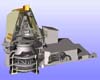
Haleakala atop Maui, Hawaii, was recommended as the future site of the world's largest optical solar telescope, with a final decision to be made in December based on logistical and other issues. |
|
|

| The content herein, unless otherwise known to be public domain, are Copyright 1995-2006 - SpaceDaily.AFP and UPI Wire Stories are copyright Agence France-Presse and United Press International. ESA PortalReports are copyright European Space Agency. All NASA sourced material is public domain. Additionalcopyrights may apply in whole or part to other bona fide parties. Advertising does not imply endorsement,agreement or approval of any opinions, statements or information provided by SpaceDaily on any Web page published or hosted by SpaceDaily. Privacy Statement |