|
 |
 |
 |
 |
 |
 |
 |
 |
 |

| . |  |
. |
Cassini Opens A Cosmic Time Capsule
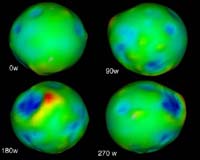
Pasadena (JPL) Jun 24, 2004 Like a woolly mammoth trapped in Arctic ice, Saturn's small moon Phoebe may be a frozen artifact of a bygone era, some four billion years ago. The finding is suggested by new data from the Cassini spacecraft. Cassini scientists reviewed data from the spacecraft's June 11, 2004, flyby of the diminutive moon. They concluded Phoebe is likely a primordial mixture of ice, rock and carbon-containing compounds similar in many ways to material seen in Pluto and Neptune's moon Triton. Scientists believe bodies like Phoebe were plentiful in the outer reaches of the solar system about four and half billion years ago. These icy planetesimals (small bodies) formed the building blocks of the outer solar system and some were incorporated into the giant planets Jupiter, Saturn, Uranus and Neptune. During this process, gravitational interactions ejected much of this material to distant orbits, joining a native population of similar bodies to form the Kuiper Belt. "Phoebe apparently stayed behind, trapped in orbit about the young Saturn, waiting eons for its secrets to be revealed during its rendezvous with the Cassini spacecraft," said Dr. Torrence Johnson, Cassini imaging team member at NASA's Jet Propulsion Laboratory (JPL), Pasadena, Calif. "All our evidence leads us to conclude, Phoebe's surface is made of water ice, water-bearing minerals, carbon dioxide, possible clays and primitive organic chemicals in patches at different locations on the surface," said Dr. Roger N. Clark, team member for the Visual and Infrared Mapping Spectrometer, U.S. Geological Survey in Denver. "We also see spectral signatures of materials we have not yet identified." Cassini's observations gave scientists the first detailed look at one of these primitive icy planetesimals. Phoebe's mass was determined from precise tracking of the spacecraft and optical navigation, combined with an accurate volume estimate from images. The measurements yield a density of about 1.6 grams per cubic centimeter (100 pounds per cubic foot), much lighter than most rocks, but heavier than pure ice at approximately 0.93 grams per cubic centimeter (58 pounds per cubic foot). This suggests a composition of ice and rock similar to Pluto and Triton. Spectral measurements, light intensity as a function of color or wavelength, confirmed the presence of water ice previously detected by Earth-based telescopes. The measurements provided evidence for hydrated minerals on Phoebe's surface, detected carbon dioxide and solid hydrocarbons similar to those found in primitive meteorites. "One intriguing result is the discovery of possible chemical similarities between the materials on Phoebe and those seen on comets," said Dr. Robert H. Brown, team leader for the Visible and Infrared Mapping Spectrometer, University of Arizona, Tucson. Evidence Phoebe might be chemically kin to comets strengthens the case it is similar to Kuiper Belt Objects. Measurements taken by the Composite Infrared Spectrometer were used to generate temperature maps. The maps show the surface of Phoebe is very cold, only about 110 degrees above absolute zero (-163 degrees Celsius, or -261 degrees Fahrenheit). Even colder nighttime temperatures suggest a fluffy, porous surface layer. "One of the first results from this map is the surface of Phoebe has been badly chewed up, probably by meteorite impacts," said Dr. John Pearl, a Cassini co-investigator for the Composite Infrared Spectrometer, at NASA's Goddard Space Flight Center, Greenbelt, Md. "We are discovering Phoebe is a very complex object, with large variations in topography." Cassini also made radar observations of Phoebe's enigmatic surface, making it the first spacecraft radar observations of an outer-planet moon. The results are consistent with the dirty, rocky, icy surface suggested by other observations. "We have conducted our first analysis of an outer solar system resident akin to Kuiper Belt Objects," said Dr. Dennis Matson, project scientist of the Cassini-Huygens mission at JPL. "In two short weeks, we have added more to what we know about Phoebe than we had learned about it since it was discovered 100 years ago. We did this by having multiple instruments conducting investigations all at one time during our flyby," Matson said. Related Links Cassini-Huygens at JPL SpaceDaily Search SpaceDaily Subscribe To SpaceDaily Express  Cassini VIMS Team Finds That Phoebe May Be Kin To Comets
 Pasadena (JPL) Jun 24, 2004
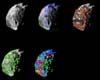
Scientists may at last have settled the debate on the origin of Saturn's moon, Phoebe. Saturn long ago captured its largest outermost satellite, Phoebe, when the moon wandered in from the frigid region beyond the orbit of Neptune called the Kuiper belt, they conclude. |
|
|

| The content herein, unless otherwise known to be public domain, are Copyright 1995-2006 - SpaceDaily.AFP and UPI Wire Stories are copyright Agence France-Presse and United Press International. ESA PortalReports are copyright European Space Agency. All NASA sourced material is public domain. Additionalcopyrights may apply in whole or part to other bona fide parties. Advertising does not imply endorsement,agreement or approval of any opinions, statements or information provided by SpaceDaily on any Web page published or hosted by SpaceDaily. Privacy Statement |