|
 |
 |
 |
 |
 |
 |
 |
 |
 |

| . |  |
. |
Cassini VIMS Team Finds That Phoebe May Be Kin To Comets
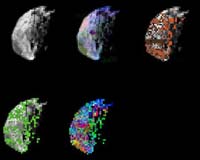
Pasadena (JPL) Jun 24, 2004 Scientists may at last have settled the debate on the origin of Saturn's moon, Phoebe. Saturn long ago captured its largest outermost satellite, Phoebe, when the moon wandered in from the frigid region beyond the orbit of Neptune called the Kuiper belt, they conclude. The scientists analyzed results from the Cassini Visual and Infrared Mapping Spectrometer (VIMS) taken during the June 11 Cassini spacecraft's Phoebe flyby. They announced the results today at a news conference at the NASA Jet Propulsion Laboratory in Pasadena, Calif. Scientists have long doubted that Phoebe came from the same disk of material that formed Saturn and most of its moons. Phoebe has an unusual orbit that is inclined to Saturn's equator, revolves backward with respect to both Saturn's rotation and orbital motion, and travels in the opposite direction of Saturn's other satellites. Phoebe is widely believed to have wandered past Saturn and been captured by that planet's mighty gravitational field. Where it wandered from was the question. "All our evidence leads us to conclude that Phoebe's surface is made of water ice, water-bearing minerals, carbon dioxide, possible clays and primitive organic chemicals in different locations on the surface," VIMS team member Roger N. Clark of the U.S. Geological Survey in Denver said a few days after the flyby. "We also see spectral signatures of materials that we have not yet identified." It is clear that the materials in Phoebe's surface bear little resemblance to the predominantly rocky material found in asteroids in the belt between Mars and Jupiter. The materials that make up Phoebe formed farther out in the solar system, where it is cold enough for them to remain stable. "One intriguing result of the VIMS measurements is the discovery of possible chemical similarities between the materials on Phoebe and those seen on comets," said VIMS team leader Robert H. Brown of the University of Arizona. Short period comets are thought to sit among other primitive solar system debris in the Kuiper belt, until tugged by Neptune's gravity toward the inner solar system. Evidence that Phoebe might be chemically kin to comets strengthens the case that it's similar to Kuiper Belt Objects. The VIMS instrument is an imaging spectrometer that produces a special data set called an image cube. It takes an image of an object in many colors simultaneously. An ordinary video camera takes images in three primary colors (red, green, and blue) and combines them to produce images as seen by the human eye. The VIMS instrument takes images in 352 separate colors, spanning a realm of colors far beyond those visible to humans. All materials reflect light in a unique way. So molecules of any element or compound can be identified by the colors they reflect or absorb, their "signature" spectra. The VIMS team knew the basic chemical make-up of Phoebe only a few days after flyby. That Phoebe likely comes from the Kuiper belt and not from the Mars-Jupiter asteroid belt is another "first" for the Cassini mission, Brown noted. Cassini has become the first spacecraft to flyby a Kuiper belt object, he said. Cassini flew by Phoebe on June 11. Cassini will conduct a critical 96-minute main-engine burn before going into orbit around Saturn on June 30 (July 1 Universal Time). During Cassini's planned four-year tour it will conduct 76 orbits around the Saturn system and execute 52 close encounters with seven of Saturn's 31 known moons. Related Links VIMS at Arizona Cassini at NASA SpaceDaily Search SpaceDaily Subscribe To SpaceDaily Express  Cassini Opens A Cosmic Time Capsule
 Pasadena (JPL) Jun 24, 2004
Like a woolly mammoth trapped in Arctic ice, Saturn's small moon Phoebe may be a frozen artifact of a bygone era, some four billion years ago. The finding is suggested by new data from the Cassini spacecraft. |
|
|

| The content herein, unless otherwise known to be public domain, are Copyright 1995-2006 - SpaceDaily.AFP and UPI Wire Stories are copyright Agence France-Presse and United Press International. ESA PortalReports are copyright European Space Agency. All NASA sourced material is public domain. Additionalcopyrights may apply in whole or part to other bona fide parties. Advertising does not imply endorsement,agreement or approval of any opinions, statements or information provided by SpaceDaily on any Web page published or hosted by SpaceDaily. Privacy Statement |