|
 |
 |
 |
 |
 |
 |
 |
 |
 |

| . |  |
. |
Cassini Reveals New Saturn Ring Features
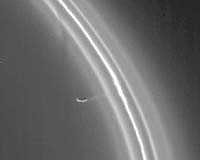
Leicester England (SPX) Apr 3, 2006 The latest Cassini spacecraft images of Saturn's F ring have revealed structures never seen before in a planetary ring system. Using images obtained by Cassini's Imaging Science Subsystem cameras, astronomers at Queen Mary College, part of the University of London, modeled the dynamics of the structures, which they call channels and streamers, to test their dynamics and predict their behavior. Ever since the Voyager spacecraft imaged the tiny shepherd moons orbiting Saturn along with its rings in the early 1980s, astronomers have suspected that all of the giant planets in the solar system are stabilized by the gravitational effects of shepherds. Saturn's narrow F ring, which lies just outside the spectacular main rings, is tended by two such small moons: Prometheus (about 100 kilometers or 64 miles in diameter), orbiting just inside the F ring, and Pandora (85 kilometers or 53 miles wide), orbiting just outside the F ring. "The models are in excellent agreement with structures observed in the Cassini images," said team leader Carlos Chavez. "We have found that the gaps are not due to a lack of particles, but to a forced change in orbital elements by a close encounter with Prometheus. The moon's gravity temporarily pulls some of the particles away from the main stream as it passes by." Speaking at the annual meeting of the Royal Astronomical Society, Chavez described the dynamics of the structures as "like a crowd of people walking in a number of lines in the same direction down a street. Suddenly, someone else comes from the other side of the street and collides with a few of them. He then tells them to come with him, and walks away. Only people in the closest lines follow him, which produces gaps in the crowd. However, they return back to the main group shortly afterwards." Chavez said the most dramatic illustration of the effect will occur in late 2009, when the F ring and Prometheus become anti-aligned. Once per orbit during this anti-alignment, Prometheus will reach apoapsis - its furthest point from Saturn - and the nearby ring particles will reach periapsis � their closest point to Saturn. At that time, Prometheus and the ring particles move closest to one another other. When the Queen Mary team modeled how these events will affect collisions between the ring particles and Prometheus, they found a low number of collisions � only 0.6 percent of the particles collided per orbit. The result was unexpected, they said, because they originally thought Prometheus is a "thieving moon," stealing particles from the F ring. It turns out the particles are pulled away only temporarily, but then drift back into the ring. The astronomers said the ring-moon interactions also probably affect the surface of Prometheus. Like Earth's moon and most other planetary satellites, Prometheus has a synchronous rotation, always showing the same face to Saturn. The team investigated the location on Prometheus' surface where the particles would be expected to collide. They found that, in the synchronous co-rotating reference frame, the collisions occurred on the trailing face of Prometheus - and particularly in the equatorial region. Chavez said the scenario offers important implications for the surface features of Prometheus, and with further observations the team expects to find differences in albedo, or reflectivity, between the trailing and leading faces. "It would be like a man colliding with other people while facing continuously in a particular direction and hitting them with only one side of his body," he explained. Related Links Cassini Cassini Images JPL  Rhea And The Rings
 Ithaca NY (SPX) Apr 1, 2006
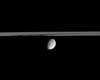
Saturn's crater-scarred moon Rhea floats in the distance, peeking out from behind the giant planet's partly shadowed rings. This view looks upward from just beneath the ring plane. The far side of the rings is masked by Saturn's shadow. The north pole of Rhea is obscured by part of the A ring and the sharply defined F ring. |
|
|

| The content herein, unless otherwise known to be public domain, are Copyright 1995-2006 - SpaceDaily.AFP and UPI Wire Stories are copyright Agence France-Presse and United Press International. ESA PortalReports are copyright European Space Agency. All NASA sourced material is public domain. Additionalcopyrights may apply in whole or part to other bona fide parties. Advertising does not imply endorsement,agreement or approval of any opinions, statements or information provided by SpaceDaily on any Web page published or hosted by SpaceDaily. Privacy Statement |