
. Military Space News .
PHYSICS NEWS
Cells adapt ultra-rapidly to zero gravity
by Staff Writers
Zurich, Switzerland (SPX) Mar 01, 2017


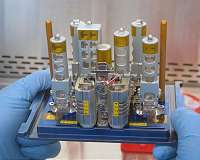
Front plate of the experiment equipment is shown. Image courtesy C. Thiel und Airbus DS.

Mammalian cells are optimally adapted to gravity. But what happens in the microgravity environment of space if the earth's pull disappears? Previously, many experiments exhibited cell changes - after hours or even days in zero gravity. Astronauts, however, returned to Earth without any severe health problems after long missions in space, which begs the question as to how capable cells are of adapting to changes in gravity.

Based on real-time readings on the ISS, UZH scientists can now reveal that cells are able to respond to changes in gravitational conditions extremely quickly and keep on functioning. Therefore, the study also provides direct evidence that certain cell functions are linked to gravity.

Test setup and measurement on the ISS
In contrast to space experiments, where analyses are conducted afterwards on Earth, the team headed by UZH scientists Oliver Ullrich and Cora Thiel opted for a different path.

They geared their experimental design towards conducting direct measurements in space: From thawing the test cells to the measurements themselves, ESA astronaut Samantha Cristoforetti performed all the operations directly in the lab on the ISS. The data gathered on the space station was then transmitted to Earth. Rigorous internal and external controls excluded any influence other than gravity.

Cell adaptation in 42 seconds
The research team used the so-called oxidative burst - an old evolutionary mechanism to kill off bacteria via defense cells - to study how rat cells responded to changes in gravity. With the aid of centrifuges, Cristoforetti altered the gravitational conditions on the ISS, which enabled the team in the control center to track how the cells reacted. "Ultra-rapidly," explains Oliver Ullrich, a professor from the Institute of Anatomy at the University of Zurich.

"Although the immune defense collapsed as soon as zero gravity hit, to our surprise the defense cells made a full recovery within 42 seconds." For Ullrich and Thiel, the direct evidence of a rapid and complete adaptation to zero gravity in less than a minute begs the question as to whether previous cell changes measured after hours or days were also the result of an adaptation process.

Good news for astronauts
"It seems paradoxical," says Thiel: "Cells are able to adapt ultra-rapidly to zero gravity. However, they were never exposed to it in the evolution of life on Earth. Therefore, the results raise more questions regarding the robustness of life and its astonishing adaptability."

In any case, as far as Ullrich is concerned the result of the ISS experiment is good news for manned space flight: "There's hope that our cells are able to cope much better with zero gravity than we previously thought."

Space experiment
The research material used by Professor Ullrich and Doctor Thiel was transported to the ISS on the SpaceX-CRS-6 mission by a Falcon 9 rocket and the Dragon space station on April 14, 2015. The research mission was funded by the European Space Agency (ESA) and the German Aerospace Center (DLR).

After years of preparation, the ESA astronaut Samantha Cristoforetti conducted the experiments in the BIOLAB of the COLUMBUS Module on the ISS. The University of Zurich headed the experiment in collaboration with Otto-von-Guericke-University Magdeburg, the Technical University of Munich, Lucerne University of Applied Sciences and Arts, the European Space Agency (ESA), the German Aerospace Center (DLR) and NASA's Kennedy Space Center.

Cora S. Thiel, Diane de Zelicourt, Svantje Tauber, Astrid Adrian, Markus Franz, Dana M. Simmet, Kathrin Schoppmann, Swantje Hauschild, Sonja Krammer, Miriam Christen, Gesine Bradacs, Katrin Paulsen, Susanne A. Wolf, Markus Braun, Jason Hatton, Vartan Kurtcuoglu, Stefanie Franke, Samuel Tanner, Samantha Cristoforetti, Beate Sick, Bertold Hock and Oliver Ullrich. Rapid adaptation to microgravity in mammalian macrophage cells. Scientific Reports 7, Article number: 43 (2017). February 27, 2017. DOI: 10.1038/s41598-017-00119-6

PHYSICS NEWS
'Gravitational noise' interferes with determining distant sources
Moscow, Russia (SPX) Feb 22, 2017
Our Galaxy's gravitational field limits the accuracy of astrometric observations of distant objects. This is most clearly appeared for objects that are visually located behind the central regions of the Galaxy and the Galactic plane, where the deviation can be up to several dozen microarcseconds. And, more importantly, the effect of this gravitational "noise" cannot be removed. This means ... read more

Related Links
University of Zurich
The Physics of Time and Space


Thanks for being here;
We need your help. The Space Media Network continues to grow but revenues have never been harder to maintain.

With the rise of Ad Blockers, and Facebook - our traditional revenue sources via quality network advertising continues to decline. And unlike so many other news sites, we don't have a paywall - with those annoying usernames and passwords.

Our news coverage takes time and effort to publish 365 days a year.

If you find our news sites informative and useful then please consider becoming a regular supporter or for now make a one off contribution.
SpaceMediaNetwork Contributor
$5 Billed Once


credit card or paypal
SpaceMediaNetwork Monthly Supporter
$5 Billed Monthly


paypal only


Comment on this article using your Disqus, Facebook, Google or Twitter login.

Share this article via these popular social media networks
del.icio.usdel.icio.us DiggDigg RedditReddit GoogleGoogle

PHYSICS NEWS
India stages successful test of missile interceptor

Protesters sue to stop US missile system in S. Korea

Jenoptik contracted for Patriot missile components

Raytheon developing new tool for war game assessment

PHYSICS NEWS
Iran's S-300 air defence system operational

ATK unit contracted for U.S. AIM-9P Sidewinder missile motors

U.S. Army exercises option for more Hellfire II missiles

Iran tests missiles in naval exercises

PHYSICS NEWS
Drone Aviation Delivers Enhanced WASP Tactical Aerostat to DoD

Northrop Grumman begins flight tests with MS-177 sensor

Schiebel taps Leonardo for radar system for unmanned helicopter

Leonardo rotary drone demonstrator program enters phase 2

PHYSICS NEWS
Rockwell Collins, Australian air force test WBHF communication system

Space aggressors jam AF, allies' systems

General Dynamics gets enterprise communications contract

Harris intros new wideband manpack radio system

PHYSICS NEWS
Navistar to upgrade MRAP vehicles for UAE

Orbital ATK production of artillery shell guidance kits tops 10,000

Unidentified country orders Saab target vehicle system

Jacobs to provide support for U.S. Marines weapons system

PHYSICS NEWS
Trump to press Congress for defense spending boost

BAE Systems eyes defence spending by Trump

UAE signs over $5 bln in deals at arms fair

Pentagon chief says military running smoothly amid turbulent transition

PHYSICS NEWS
China defence spending to rise 7 percent

Philippine defence chief visits US carrier in S. China Sea

Russia, NATO in first high-level military talks since freeze

Putin, Poroshenko held two rounds of secret phone talks: Kiev

PHYSICS NEWS
Most complex nanoparticle crystal ever made by design

Nano 'sandwich' offers unique properties

Scientists create a nano-trampoline to probe quantum behavior

Scientists decipher the nanoscale architecture of a beetle's shell


The content herein, unless otherwise known to be public domain, are Copyright 1995-2024 - Space Media Network. All websites are published in Australia and are solely subject to Australian law and governed by Fair Use principals for news reporting and research purposes. AFP, UPI and IANS news wire stories are copyright Agence France-Presse, United Press International and Indo-Asia News Service. ESA news reports are copyright European Space Agency. All NASA sourced material is public domain. Additional copyrights may apply in whole or part to other bona fide parties. All articles labeled "by Staff Writers" include reports supplied to Space Media Network by industry news wires, PR agencies, corporate press officers and the like. Such articles are individually curated and edited by Space Media Network staff on the basis of the report's information value to our industry and professional readership. Advertising does not imply endorsement, agreement or approval of any opinions, statements or information provided by Space Media Network on any Web page published or hosted by Space Media Network. General Data Protection Regulation (GDPR) Statement Our advertisers use various cookies and the like to deliver the best ad banner available at one time. All network advertising suppliers have GDPR policies (Legitimate Interest) that conform with EU regulations for data collection. By using our websites you consent to cookie based advertising. If you do not agree with this then you must stop using the websites from May 25, 2018. Privacy Statement. Additional information can be found here at About Us.