|
 |
 |
 |
 |
 |
 |
 |
 |
 |

| . |  |
. |
Chandra Catches Early Phase Of Cosmic Assembly
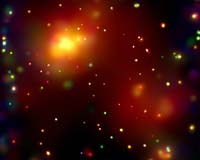
Huntsville AL (SPX) Aug 16, 2004 A NASA Chandra X-ray Observatory image has revealed a complex of several intergalactic hot gas clouds in the process of merging. The superb Chandra spatial resolution made it possible to distinguish individual galaxies from the massive clouds of hot gas. One of the clouds, which envelopes hundreds of galaxies, has an extraordinarily low concentration of iron atoms, indicating that it is in the very early stages of cluster evolution. The Marshall Center manages the Chandra program. A NASA Chandra X-ray Observatory image has revealed a complex of several intergalactic hot gas clouds in the process of merging. The superb Chandra spatial resolution made it possible to distinguish individual galaxies from the massive clouds of hot gas. One of the clouds, which envelopes hundreds of galaxies, has an extraordinarily low concentration of iron atoms, indicating that it is in the very early stages of cluster evolution. "We may be seeing hot intergalactic gas in a relatively pristine state before it has been polluted by gas from galaxies," said Q. Daniel Wang of the University of Massachusetts in Amherst, and lead author on an upcoming Astrophysical Journal article describing the study. "This discovery should provide valuable insight into how the most massive structures in the universe are assembled." The complex, known as Abell 2125, is about 3 billion light years from Earth and is seen at a time about 11 billion years after the Big Bang. This is a period when astronomers believe many galaxy clusters are formed. Chandra's Abell 2125 image shows several huge elongated clouds of multimillion-degree-gas coming together from different directions. These hot gas clouds, each of which contains hundreds of galaxies, appear to be in the process of merging to form a single massive galaxy cluster. Chandra, Hubble Space Telescope, and Very Large Array radio telescope data show that several galaxies in the Abell 2125 core cluster are being stripped of their gas as they fall through surrounding high-pressure hot gas. This stripping process has enriched the core cluster's gas in heavy elements such as iron. The gas in the pristine cloud, which is still several million light years away from the core cluster, is conspicuous for its lack of iron atoms. This anemic cloud must be in a very early evolutionary stage. The iron atoms produced by supernovas in the embedded galaxies must still be contained in and around the galaxies, perhaps in grains of dust not well mixed with the observed X-ray-emitting gas. Over time, as the cluster merges with the other clusters and the hot gas pressure increases, the dust grains will be driven from the galaxies, mixed with the hot gas, and destroyed, liberating the iron atoms. Building a massive galaxy cluster is a step-by-step enterprise that takes billions of years. Exactly how long it takes for such a cluster to form depends on many factors, such as the density of subclusters in the vicinity, the rate of the expansion of the universe, and the relative amounts of dark energy and dark matter. Cluster formation also involves complex interactions between the galaxies and the hot gas that may determine how large the galaxies in the cluster can ultimately become. These interactions determine how the galaxies maintain their gas content, the fuel for star formation. The observations of Abell 2125 provide a rare glimpse into the early steps in this process. Frazer Owen (National Radio Astronomy Observatory) and Michael Ledlow (Gemini Observatory) are co-authors on the upcoming Astrophysical Journal paper. Chandra observed Abell 2125 with its Advanced CCD Imaging Spectrometer on August 24, 2001, for approximately 22 hours. Related Links Chandra at Harvard NRAO Very Large Array radio telescope SpaceDaily Search SpaceDaily Subscribe To SpaceDaily Express  Trajectory Maneuver Brings Spacecraft Closer To Home
 Pasadena CA (JPL) Aug 12, 2004
Thirty days before its historic return to Earth with NASA's first samples from space since the Apollo missions, the Genesis spacecraft successfully completed its twentieth trajectory maneuver. |
|
|

| The content herein, unless otherwise known to be public domain, are Copyright 1995-2006 - SpaceDaily.AFP and UPI Wire Stories are copyright Agence France-Presse and United Press International. ESA PortalReports are copyright European Space Agency. All NASA sourced material is public domain. Additionalcopyrights may apply in whole or part to other bona fide parties. Advertising does not imply endorsement,agreement or approval of any opinions, statements or information provided by SpaceDaily on any Web page published or hosted by SpaceDaily. Privacy Statement |