
 |
 |
 |
 |
 |
 |
 |
 |
 |
 |

| . |  |
. |

Washington DC (SPX) Aug 13, 2010 Idle computers are the astronomers' playground: Three citizen scientists--an American couple and a German--have discovered a new radio pulsar hidden in data gathered by the Arecibo Observatory. This is the first deep-space discovery by Einstein@Home, which uses donated time from the home and office computers of 250,000 volunteers from 192 different countries. This is the first genuine astronomical discovery by a public volunteer distributed computing project. The details of their discovery and the process of getting there are revealed in a paper published in the Aug. 12 edition of Science Express. The new pulsar--called PSR J2007+2722--is a neutron star that rotates 41 times per second. It is in the Milky Way, approximately 17,000 light years from Earth in the constellation Vulpecula. Unlike most pulsars that spin as quickly and steadily, PSR J2007+2722 sits alone in space, and has no orbiting companion star. Astronomers consider it especially interesting since it is likely a recycled pulsar that lost its companion. However they cannot rule out that it may be a young pulsar born with an lower-than-usual magnetic field. Chris and Helen Colvin, of Ames, Iowa, and Daniel Gebhardt, of Universitat Mainz, Musikinformatik, Germany, are credited with this discovery. Their computers, along with half a million others from around the world, are harnessed to analyze data for Einstein@Home (volunteers contribute about two computers each). Einstein@Home--based at the Center for Gravitation and Cosmology at the University of Wisconsin-Milwaukee, and at the Max Planck Institute for Gravitational Physics, Albert Einstein Institute (AEI), Hannover, Germany--has been searching for gravitational waves in data from the U.S. based LIGO (Large Interferometer Gravitational Observatory) since 2005. Starting in March of 2009, Einstein@Home also began searching for signals from radio pulsars in astronomical observations from the Arecibo Observatory in Puerto Rico. Arecibo, a National Science Foundation (NSF) facility operated by Cornell University, is the world's largest and most sensitive radio telescope. About one-third of Einstein@Home's computing capacity is used to search Arecibo data. "This is a thrilling moment for Einstein@Home and our volunteers. It proves that public participation can discover new things in our universe. I hope it inspires more people to join us to help find other secrets hidden in the data," said Bruce Allen, leader of the Einstein@Home project, Max Planck Institute director and adjunct professor of physics at the University of Wisconsin-Milwaukee. The paper, "Pulsar Discovery by Global Volunteer Computing," is authored by Allen's graduate student, Benjamin Knispel from the AEI; Bruce Allen; James M. Cordes, Cornell professor of astronomy and chair of the Pulsar ALFA Consortium; and an international team of collaborators. It details the pulsar and announces the first genuine astronomical discovery by a public volunteer distributed computing project. "No matter what else we find out about it, this pulsar is bound to be extremely interesting for understanding the basic physics of neutron stars and how they form. Its discovery has required a complex system that includes the Arecibo Telescope and computing resources at the Albert Einstein Institute, at the Cornell Center for Advanced Computing, and at the University of Wisconsin-Milwaukee to be able to send data out worldwide to Einstein@Home volunteers," Cordes said. The Arecibo Observatory is funded by the NSF, which collaborates with the Max Planck Gesellschaft to support Einstein@Home. "This is an exciting development that highlights the importance of citizen science, as well as the partnerships and discoveries that arise when scientific data are shared," said Ed Seidel, assistant director for NSF's directorate for Mathematical and Physical Sciences. "Having previously led a research group at the AEI myself, I deeply understand the importance of international collaborations such as this," he added.
Share This Article With Planet Earth
Related Links National Science Foundation Stellar Chemistry, The Universe And All Within It

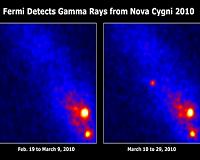 Fermi Detects Shocking Surprise From Supernova's Little Cousin
Greenbelt MD (SPX) Aug 13, 2010 Astronomers using NASA's Fermi Gamma-ray Space Telescope have detected gamma-rays from a nova for the first time, a finding that stunned observers and theorists alike. The discovery overturns the notion that novae explosions lack the power to emit such high-energy radiation. A nova is a sudden, short-lived brightening of an otherwise inconspicuous star. The outburst occurs when a white dwa ... read more |
|
|
| The content herein, unless otherwise known to be public domain, are Copyright 1995-2010 - SpaceDaily. AFP and UPI Wire Stories are copyright Agence France-Presse and United Press International. ESA Portal Reports are copyright European Space Agency. All NASA sourced material is public domain. Additional copyrights may apply in whole or part to other bona fide parties. Advertising does not imply endorsement,agreement or approval of any opinions, statements or information provided by SpaceDaily on any Web page published or hosted by SpaceDaily. Privacy Statement |


 del.icio.us
 Digg
Digg Reddit
 YahooMyWeb
 Google
 Facebook


