|
 |
 |
 |
 |
 |
 |
 |
 |
 |

| . |  |
. |
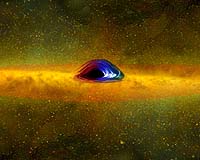
Collaboration Shines Possible Light On Objects Weirder Than Black Holes
Durham NC (SPX) Sep 27, 2007 Researchers from Duke University and the University of Cambridge think there is a way to determine whether some black holes are not actually black. Finding such an unmasked form of what physicists term a singularity "would shock the foundation of general relativity," said Arlie Petters, a Duke professor of mathematics and physics who worked with Marcus Werner, Cambridge graduate student in astrophysics, on a report posted online Monday, Sept. 24, for the research journal Physical Review D. "It would show that nature has surprises even weirder than black holes," Petters added. Albert Einstein originally theorized that stars bigger than the sun can collapse and compress into singularities, entities so confining and massively dense that the laws of physics break down inside them. Astronomers have since found indirect evidence for these entities, which are popularly known as black holes because of the "cosmic censorship conjecture." This conjecture is that "realistic" singularities -- meaning those that can be formed in nature -- must always hide within a barrier known as an "event horizon" from which light can never escape. That makes them appear perpetually black to the rest of the universe. But cosmic censorship is "an open conjecture that is very difficult to prove, and very difficult to disprove," said Petters. And, despite the general support for the universality of black holes, Kip Thorne and John Preskill, two experts in the cosmology of relativity at the California Institute of Technology, have suggested for more than a decade that naked singularities could exist in certain instances. Now Petters and Werner have devised a way to test for their presence. Astronomers cannot say for sure whether all black holes are actually black, having never fully penetrated the obscuring outward matter surrounding such objects, Petters said. As their main evidence, scientists can only point to effects that the massive gravitational pull of certain unseen entities exert on surrounding matter. Those effects include emissions of highly energetic radiation, or the extreme orbits of nearby stars. Petters is an expert in "gravitational lensing," another effect of relativity that permits massive sources of gravity to split light from background astronomical features into multiple images. In earlier reports in the November, 2005 and February, 2006 issues of Physical Review D, he and Charles Keeton of Rutgers University suggested a way to use gravitational lensing to show whether cosmic censorship can ever be violated. However, that evaluation was limited to non-spinning singularities that are considered only theoretically possible. The suspected singularities astronomers have found in space so far all appear to be rapidly spinning, sometimes at more than 1,000 times a second. So Petters and Werner teamed up to see if they could generalize such an application of gravitational lensing to all realistic spinning singularities. Their surprising result was yes, Petters said. In work supported by the National Science Foundation in the United States and the Science and Technology Facilities Council in the United Kingdom, the pair employed a finding that a black hole could be shed of its event horizon and become a naked singularity if its angular momentum -- an effect of its spin -- is greater than its mass. That would translate into a spin of a few thousand rotations a second in the case of a black hole weighing about 10 times more than our Sun, said Werner. In the event that the required conditions were met, Petters' and Werner's calculations show that a naked singularity's massive gravitation would split the light of background stars or galaxies in telltale ways that are potentially detectable by astronomers using existing or soon-to-be instruments. Those possible ways are outlined by six different equations in their study that connect a singularity's spin to the separations, angular alignments and brightness of the two split images. "If you ask me whether I believe that naked singularities exist, I will tell you that I'm sitting on the fence," said Petters. "In a sense, I hope they are not there. I would prefer to have covered-up black holes. But I'm still open-minded enough to entertain the 'otherwise' possibility." Community Email This Article Comment On This Article Related Links Duke University Understanding Time and Space
 Black Holes In Feeding Frenzy
 Honolulu, HI (SPX) Aug 06, 2007
Two UH astronomers using the Hubble Space Telescope believe they have identified what makes at least some quasars shine: the black hole at the center of a massive galaxy with little gas of its own is gobbling up material from a colliding gas-rich galaxy. The merging of two galaxies has long been thought to be an efficient way of driving gas deeply into a galaxy to feed the central black hole, but there was only indirect evidence for such a mechanism until now. |
|
|

| The content herein, unless otherwise known to be public domain, are Copyright 1995-2006 - SpaceDaily.AFP and UPI Wire Stories are copyright Agence France-Presse and United Press International. ESA PortalReports are copyright European Space Agency. All NASA sourced material is public domain. Additionalcopyrights may apply in whole or part to other bona fide parties. Advertising does not imply endorsement,agreement or approval of any opinions, statements or information provided by SpaceDaily on any Web page published or hosted by SpaceDaily. Privacy Statement |