
 |
 |
 |
 |
 |
 |
 |
 |
 |
 |

| . |  |
. |

Heidelberg, Germany (SPX) Sep 24, 2010 Stars are formed as the dense core regions of cosmic clouds of gas and dust ("molecular clouds") collapse under their own gravity. As a result, matter in these regions becomes ever denser and hotter until, finally, nuclear fusion is ignited: a star is born. This is how our own star, the Sun, came into being; the fusion processes are responsible for the Sun's light, on which life on Earth depends. The dust grains contained in the collapsing clouds are the raw material out of which an interesting by-product of star formation is made: solar systems and Earth-like planets. What happens during the earliest phases of this collapse is largely unknown. Enter an international team of astronomers led by Laurent Pagani (LERMA, Observatoire de Paris) and Jurgen Steinacker (Max Planck Institute for Astronomy, Heidelberg, Germany), who have discovered a new phenomenon which promises information about the crucial earliest phase of the formation of stars and planets: "coreshine", the scattering of mid-infrared light (which is ubiquitous in our galaxy) by dust grains inside such dense clouds. The scattered light carries information about the size and density of the dust particles, about the age of the core region, the spatial distribution of the gas, the prehistory of the material that will end up in planets, and about chemical processes in the interior of the cloud. The discovery is based on observations with NASA's SPITZER Space Telescope. As published this February, Steinacker, Pagani and colleagues from Grenoble and Pasadena detected unexpected mid-infrared radiation from the molecular cloud L 183 in the constellation Serpens Cauda ("Head of the snake"), at a distance of 360 light-years. The radiation appeared to originate in the cloud's dense core. Comparing their measurements with detailed simulations, the astronomers were able to show that they were dealing with light scattered by dust particles with diameters of around 1 micrometer (one millionth of a meter). The follow-up research that is now being published in Science clinched the case: The researchers examined 110 molecular clouds at distances between 300 and 1300 light-years, which had been observed with Spitzer in the course of several survey programs. The analysis showed that the L 183 radiation was more than a fluke. Instead, it revealed that coreshine is a widespread astronomical phenomenon: Roughly half of the cloud cores exhibited coreshine, mid-infrared radiation associated with scattering from dust grains in their densest regions. The discovery of coreshine suggests a host of follow-on projects - for the SPITZER Space Telescope as well as for the James Webb Space Telescope, which is due to be launched in 2014. The first coreshine observations have yielded promising results: The unexpected presence of larger grains of dust (diameters of around a millionth of a meter) shows that these grains begin their growth even before cloud collapse commences. An observation of particular interest concerns clouds in the Southern constellation Vela, in which no coreshine is present. It is known that this region was disturbed by several stellar (supernova) explosions. Steinacker and his colleagues hypothesize that these explosions have destroyed whatever larger dust grains had been present in this region.
Share This Article With Planet Earth
Related Links MPIA Stellar Chemistry, The Universe And All Within It

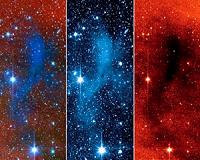 Shining Starlight On The Dark Cocoons Of Star Birth
Washington DC (SPX) Sep 24, 2010 Astronomers have discovered a new, cosmic phenomenon, termed "coreshine," which is revealing new information about how stars and planets come to be. The scientists used data from NASA's Spitzer Space Telescope to measure infrared light deflecting off cores - cold, dark cocoons where young stars and planetary systems are blossoming. This coreshine effect, which occurs when starlight from ne ... read more |
|
|
| The content herein, unless otherwise known to be public domain, are Copyright 1995-2010 - SpaceDaily. AFP and UPI Wire Stories are copyright Agence France-Presse and United Press International. ESA Portal Reports are copyright European Space Agency. All NASA sourced material is public domain. Additional copyrights may apply in whole or part to other bona fide parties. Advertising does not imply endorsement,agreement or approval of any opinions, statements or information provided by SpaceDaily on any Web page published or hosted by SpaceDaily. Privacy Statement |


 del.icio.us
 Digg
Digg Reddit
 YahooMyWeb
 Google
 Facebook


