
 |
 |
 |
 |
 |
 |
 |
 |
 |
 |

| . |  |
. |
Cosmic link to precious metals: study
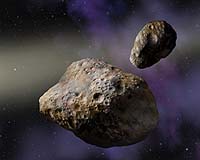
Paris (AFP) Sept 22, 2008 Rare, precious metals may owe their presence in Earth's upper crust to a bombardment of the infant planet by asteroids billions of years ago, according to a study unveiled on Monday. Gerhard Schmidt from the University of Mainz, western Germany, carried out a 12-year investigation into impact sites left by meteorites, analysing the soil for traces of these precious metals, which are called highly siderophile elements (HSE). Metals in the HSE group include gold, platinum, palladium, iridium and ruthenium. Schmidt compared these with samples from Earth's mantle and crust; from Martian meteorites that have been found on Earth; and from analysis of HSE-rich rocks, brought back by the Apollo missions, found at impact sites on the Moon. The startling similarities point to a "cosmochemical source" for terrestrial HSE, he said in a press release. He calculates that around 160 large, metal-rich asteroids in the order of 20 kilometers (12 miles) in diameter would have been enough to provide the concentrations of HSE we see today. Schmidt was scheduled to present his work at the European Planetary Science Congress, taking place this week in the German town of Muenster. Community Email This Article Comment On This Article Share This Article With Planet Earth
Related Links Stellar Chemistry, The Universe And All Within It
 Pinning Down The Milky Way's Spin
 Paris, France (SPX) Sep 22, 2008
New, very precise measurements have shown that the rotation of the Milky Way is simpler than previously thought. A remarkable result from the most successful ESO instrument HARPS, shows that a much debated, apparent 'fall' of neighbourhood Cepheid stars towards our Sun stems from an intrinsic property of the Cepheids themselves. |
|
|

| The content herein, unless otherwise known to be public domain, are Copyright 1995-2007 - SpaceDaily.AFP and UPI Wire Stories are copyright Agence France-Presse and United Press International. ESA Portal Reports are copyright European Space Agency. All NASA sourced material is public domain. Additional copyrights may apply in whole or part to other bona fide parties. Advertising does not imply endorsement,agreement or approval of any opinions, statements or information provided by SpaceDaily on any Web page published or hosted by SpaceDaily. Privacy Statement |
 del.icio.us
 Digg
Digg Reddit
 YahooMyWeb
 Google
 Facebook