include"/home2/www/vhosts/spacewar.com/swxphp/swxphp-start.php" ?>
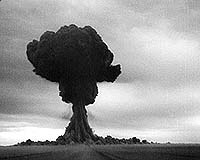
Current Nuclear Threat Worse Than During Cold War![]() File image of the first Soviet nuclear test. U.S. NGOs want to ban Kazakhstan from nuclear technologies Washington (RIA) Jul 20 - Four non-governmental organizations in the United States have called on the Bush administration to ban Kazakhstan from nuclear technologies and from buying 10% in the Westinghouse nuclear power company from Japan's Toshiba. Greenpeace, Essential Action, Knowledge Ecology International, and Nuclear Information and Resource Service opposed the deal between Kazakhstan's state company Kazatomprom and Westinghouse, saying it would undermine non-proliferation efforts and hand over sensitive nuclear technologies to the Kazakh regime, which they described as cruel, repressive and undemocratic. The organizations' letter, which has been sent to a U.S. Treasury committee for foreign investment, also said Kazakhstan's nuclear facilities and materials were not protected, and added some people in the country were involved in illegal trade in nuclear materials. |
"Both American and Russian missiles remain in a launch-on-warning mode," Perry, who served as U.S. defense secretary in 1994-97, said. "And the inherent danger of this status is aggravated by the fact that the Russian warning system has deteriorated since the ending of the Cold War."
After the collapse of the Soviet Union in the 1990s, Russia has heavily depended on its radars located abroad, particularly the Daryal facility in Azerbaijan and two Dnepr stations in Ukraine, near Sebastopol and Mukachevo.
Some reports said the outdated radar facilities that Moscow is renting on the territories of former Soviet republics were in poor conditions, and Russia had developed "holes" in its early-warning missile threat coverage.
In the same testimony, Perry blasted the Bush administration for concentrating its efforts on building defenses to protect the U.S. from a potential ballistic missile threat, while downplaying the danger of nuclear terrorism.
"The centerpiece of our government's strategy for dealing with a nuclear attack is the
National Missile Defense system now being installed in Alaska," he said.
"But the greatest danger today is that a terror group will detonate a nuclear bomb
in one of our cities," the expert said.
"Terrorists would not use a ballistic missile to deliver their bomb, they would use a truck or a freighter," Perry said, adding that a missile shield alone would not reduce the nuclear threat to the country.
Community
Washington (UPI) Jul 05, 2007| The content herein, unless otherwise known to be public domain, are Copyright 1995-2006 - SpaceDaily.AFP and UPI Wire Stories are copyright Agence France-Presse and United Press International. ESA PortalReports are copyright European Space Agency. All NASA sourced material is public domain. Additionalcopyrights may apply in whole or part to other bona fide parties. Advertising does not imply endorsement,agreement or approval of any opinions, statements or information provided by SpaceDaily on any Web page published or hosted by SpaceDaily. Privacy Statement |