
 |
 |
 |
 |
 |
 |
 |
 |
 |
 |

| . |  |
. |
Dawn Glides Into New Year
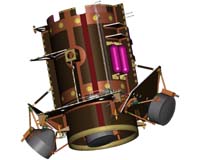
Pasadena CA (SPX) Nov 24, 2008 JPL's Dawn spacecraft shut down its ion propulsion system as scheduled. The spacecraft is now gliding toward a Mars flyby in February of next year. "Dawn has completed the thrusting it needs to use Mars for a gravity assist to help get us to Vesta," said Marc Rayman, Dawn's chief engineer, of NASA's Jet Propulsion Laboratory, Pasadena, Calif. "Dawn will now coast in its orbit around the sun for the next half a year before we again fire up the ion propulsion system to continue our journey to the asteroid belt." Dawn's ion engines may get a short workout next January to provide any final orbital adjustments prior to its encounter with the Red Planet. Ions are also scheduled to fly out of the propulsion system during some systems testing in spring. But mostly, Dawn's three ion engines will remain silent until June, when they will again speed Dawn toward its first appointment, with asteroid Vesta. Dawn's ion engines are vital to the success of the misson's 8-year, 4.9-billion-kilometer (3-billion-mile) journey to asteroid Vesta and dwarf planet Ceres. One of these extremely frugal powerhouses can generate more than 24 hours of thrusting while consuming about .26 kilograms (about 9 ounces) of the spacecraft's xenon fuel supply -- less than the contents of a can of soda. Over their lifetime, Dawn's three ion propulsion engines will fire cumulatively for about 50,000 hours (over five years) -- a record for spacecraft. Dawn will begin its exploration of asteroid Vesta in 2011 and the dwarf planet Ceres in 2015. These two icons of the asteroid belt have been witness to so much of our solar system's history. By utilizing the same set of instruments at two separate destinations, scientists can more accurately formulate comparisons and contrasts. Dawn's science instrument suite will measure shape, surface topography, tectonic history, elemental and mineral composition, and will seek out water-bearing minerals. In addition, the Dawn spacecraft itself and how it orbits both Vesta and Ceres will be used to measure the celestial bodies' masses and gravity fields. The Dawn mission to asteroid Vesta and dwarf planet Ceres is managed and operated by JPL for NASA's Science Mission Directorate, Washington, D.C. The University of California, Los Angeles, is responsible for overall Dawn mission science. Other scientific partners include: Max Planck Institute for Solar System Research, Katlenburg, Germany; DLR Institute for Planetary Research, Berlin, Germany; Italian National Institute for Astrophysics, Rome; and the Italian Space Agency. Orbital Sciences Corporation of Dulles, Virginia, designed and built the Dawn spacecraft. Share This Article With Planet Earth
Related Links Dawn The million outer planets of a star called Sol
 Nine Mementos Headed To The Ninth Planet
 Washington DC (SPX) Oct 24, 2008
PI's note: For this installment of the PI Perspective, I wanted to share with you my remarks from a ceremony on Oct. 17, during which we "inducted" the New Horizons model into the Smithsonian National Air and Space Museum's Udvar-Hazy Center, and celebrated the mission's accomplishments since launch. It was also the first time we revealed publicly the full set of commemorative items on New Horizons. - Alan Stern |
|
|

| The content herein, unless otherwise known to be public domain, are Copyright 1995-2007 - SpaceDaily.AFP and UPI Wire Stories are copyright Agence France-Presse and United Press International. ESA Portal Reports are copyright European Space Agency. All NASA sourced material is public domain. Additional copyrights may apply in whole or part to other bona fide parties. Advertising does not imply endorsement,agreement or approval of any opinions, statements or information provided by SpaceDaily on any Web page published or hosted by SpaceDaily. Privacy Statement |
 del.icio.us
 Digg
Digg Reddit
 YahooMyWeb
 Google
 Facebook