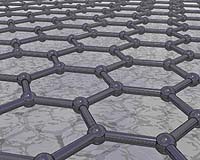
Graphene is made from a one-atom-thick layer of carbon atoms and is the world's thinnest material.
Graphene is made from a one-atom-thick layer of carbon atoms and is the world's thinnest material. |
Working with Portuguese theorists from The University of Minho in Portugal, Geim and colleagues report their findings online in the latest edition of Science Express. The paper will be published in the journal Science in the coming weeks.
The universe and life on this planet are intimately controlled by several exact numbers; so-called fundamental or universal constants such as the speed of light and the electric charge of an electron.
Among them, the fine structure constant is arguably most mysterious. It defines the interaction between very fast moving electrical charges and light - or electromagnetic waves - and its exact value is close to 1/137.
Prof Geim, who in 2004 discovered graphene with Dr Kostya Novoselov, a one-atom-thick gauze of carbon atoms resembling chicken wire, says: "Change this fine tuned number by only a few percent and the life would not be here because nuclear reactions in which carbon is generated from lighter elements in burning stars would be forbidden. No carbon means no life."
Geim now working together with PhD students Rahul Nair and Peter Blake have for the first time produced large suspended membranes of graphene so that one can easily see light passing through this thinnest of all materials. The researchers have found the carbon monolayer is not crystal-clear but notably opaque, absorbing a rather large 2.3 percent of visible light. The experiments supported by theory show this number divided by Pi gives you the exact value of the fine structures constant.
The fundamental reason for this is that electrons in graphene behave as if they have completely lost their mass, as shown in the previous work of the Manchester group and repeated by many researchers worldwide.
The accuracy of the optical determination of the constant so far is relatively low, by metrological standards.
But researchers say the simplicity of the Manchester experiment is "truly amazing" as measurements of fundamental constants normally require sophisticated facilities and special conditions.
With large membranes in hand, Prof Geim says it requires barely anything more sophisticated then a camera to measure visual transparency of graphene.
"We were absolutely flabbergasted when realized that such a fundamental effect could be measured in such a simple way. One can have a glimpse of the very foundations of our universe just looking through graphene," said Prof Geim.
"Graphene continues to surprise beyond the wildest imagination of the early days when we found this material."
"I was rather pessimistic about graphene-based technologies coming out of research labs any time soon. I have to admit I was wrong. They are coming sooner rather than later."
Community
 2,500 Researchers, One Supermachine, One New Snapshot Of The Universe
 Montreal, Canada (SPX) Apr 02, 2008
| The content herein, unless otherwise known to be public domain, are Copyright 1995-2007 - SpaceDaily.AFP and UPI Wire Stories are copyright Agence France-Presse and United Press International. ESA Portal Reports are copyright European Space Agency. All NASA sourced material is public domain. Additional copyrights may apply in whole or part to other bona fide parties. Advertising does not imply endorsement,agreement or approval of any opinions, statements or information provided by SpaceDaily on any Web page published or hosted by SpaceDaily. Privacy Statement |