
MILTECH
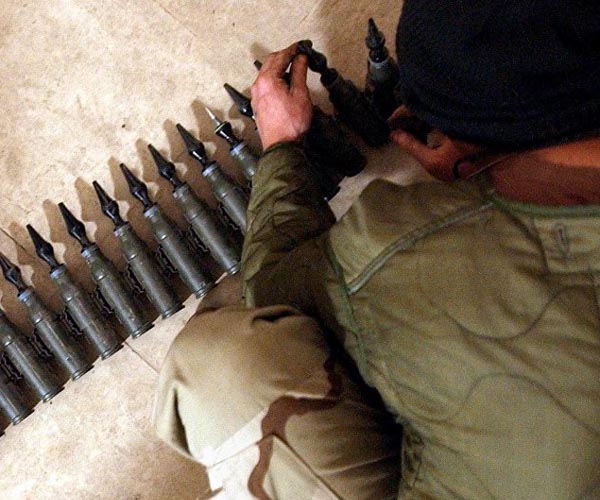
Depleted uranium munitions didn't cause Gulf War Illness, study says
by Christen Mccurdy
Washington DC (UPI) Feb 18, 2021

Veterans with Gulf War Illness don't have any more depleted uranium in their bodies than veterans of the same conflict who never got sick, a new study says.

The study, published Thursday in Scientific Reports, is the first to investigate the link between depleted uranium from exploding munitions and Gulf War Illness, a chronic multi-symptom illness afflicting about 25% of those who served in the 1991 Gulf War.

Some sufferers from the syndrome have long suspected they got it from uranium in exploded munitions.

But Robert Haley, M.D., director of the division of epidemiology at University of Texas Southwestern, and Randall Parrish, Ph.D., professor of isotope geology at the University of Portsmouth in England, found no differences in the secretion of uranium isotopic ratios from those meeting the criteria for the illness and from Gulf War veterans in the control group.

"That depleted uranium is not and never was in the bodies of those who are ill at sufficient quantities to cause disease will surprise many, including sufferers who have, for 30 years, suspected depleted uranium may have contributed to their illness," Parrish said in a press release.

The military has used deployed uranium for tank armor and munitions since the 1990s.

The National Academy of Medicine has released numerous Department of Veterans Affairs-supported reports on possible causes of the illness, and researchers have noted that Gulf War veterans were exposed to a long list of hazards not seen in previous conflicts, making it difficult to single out a cause.

Suspected culprits have included physical and psychological stresses of war, pesticide or nerve gas exposure, pyridostigmine bromide pills taken by troops to protect against nerve agents, vaccinations for in-theater infections and toxins and exposure to downwind oil and smoke that spewed for months from hundreds of burning oil wells -- as well as depleted uranium munitions.

Symptoms of GWI are similar to those associated with autonomic nervous system abnormalities and dysfunction of the brain's cholinergic system and include fatigue, fever, night sweats, memory and concentration problems, diarrhea, sexual dysfunction and chronic body pain.


Related Links
The latest in Military Technology for the 21st century at SpaceWar.com

MILTECH
Finland approved by State Department for $91.2M rocket launcher purchase
Washington DC (UPI) Feb 17, 2021
The sale of multiple launch rocket systems to Finland was approved by the State Department, the Defense Security Cooperation Agency announced on Wednesday. The potential $91.2 million deal, with Lockheed Martin Missile and Fire Control as its sole contractor, still requires approval by the U.S. Senate, DSCA said in a press release. The sale would include M30A2 and M31A2 Extended Range Guided Multiple Launch Rocket Systems, quality assurance testing services, and technical and logistical ... read more

Comment using your Disqus, Facebook, Google or Twitter login.

Share this article via these popular social media networks
del.icio.usdel.icio.us DiggDigg RedditReddit GoogleGoogle

MILTECH
US renews call on Turkey to dump Russian missile system

Turkey hints at compromise with US over Russian missiles

China tests its missile interception equipment

Hypersonic and Ballistic Tracking Space Sensor Phase IIb Awards

MILTECH
State Department approves possible $197M missile sale to Egypt

Northrop Grumman to Develop Advanced Air-to-Air Missile Engagement Concept

State Department approves $85M missile sale to Chile

U.S. Navy to arm amphibious vessels with long-range missiles

MILTECH
NATO AGS drone reaches initial operational readiness

Commercial 1-ton cargo delivery glider to be scaled down for expanded military operations

Flying fire watch

French Armed Forces selects Airbus Survey Copter Aliaca fixed-wing drone

MILTECH
Northrop Grumman gets $3.6B for work on Air Force communications node

Skynet 6A passes Preliminary Design Review

Northrop Grumman lands $325M deal for Air Force JSTARS sustainment

ThinKom completes Over-the-Air tests with K/Q-Band antenna on protected comms satellite

MILTECH
Marine Corps receives first variant of new amphibious combat vehicle

US Army selects Lockheed Martin to integrate and test combat vehicle protection system

Finland approved by State Department for $91.2M rocket launcher purchase

BAE Systems awarded $184M for 36 more amphibious combat vehicles

MILTECH
Biden maintains tough line on Turkey over Russia arms

Japan's Kirin cuts ties with Myanmar military-owned firm

Austin asks hundreds of Pentagon policy advisers to resign

Biden administration pauses arms deals with UAE, Saudi Arabia for review

MILTECH
U.S. Navy ship sails by China-claimed islands in South China Sea

Russian fighters intercept French jets over Black Sea

Biden renews 'Quad' with allies despite Beijing pressure

New Pentagon chief to reassure NATO allies

MILTECH
Nanowire could provide a stable, easy-to-make superconducting transistor

New technique builds super-hard metals from nanoparticles

Scientists see competition of magnetic orders from 2D sheets of atoms

Atomic-scale nanowires can now be produced at scale