|
 |
 |
 |
 |
 |
 |
 |
 |
 |

| . |  |
. |
ESO's VLT Launches Laser Guide Star
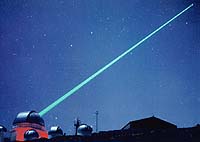
Cerro Paranal, Chile (SPX) Feb 23, 2006 Astronomers at the European Southern Observatory's Very Large Telescope array have created an artificial laser guide star that makes it possible to apply the instrument's adaptive-optics system that counteracts the blurring effect of the atmosphere. ESO ignited a laser beam of several watts on Jan. 28 at Yepun, the fourth 8.2-meter telescope in the array. The artificial star, located 90 kilometers (57.6 miles) up in the atmosphere, is about 20 times fainter than the faintest star that can be seen with the unaided eye, but it is bright enough for the VLT's adaptive optics to measure and correct atmospheric blurring, thereby giving astronomical images much greater clarity. The guide star is the culmination of five years of collaborative work by a team of scientists and engineers from ESO and the Max Planck Institutes for Extraterrestrial Physics in Garching and for Astronomy in Heidelberg, Germany. After more than one month of integration on site, the VLT Laser Guide Star Facility saw first light and propagated into the sky a 50-centimeter (20-inch) wide yellow beam. "This event tonight marks the beginning of the Laser Guide Star Adaptive Optics era for ESO's present and future telescopes", said Domenico Bonaccini Calia, head of the ESO's Laser Guide Star group and the LGSF project manager. The image sharpness of ground-based telescopes is limited significantly by the effect of atmospheric turbulence. Scientists eventually discovered how to surmount this drawback with adaptive optics, computer-controlled motors that can adjust the angle of a telescope's mirror by tiny amounts many times per second, and render images as sharp as those taken from space. Adaptive optics allows astronomers to study fainter objects and finer details in all astronomical objects. In order to work, however, adaptive optics systems need a relatively bright reference star. Astronomers can use either a known nearby star of sufficient brightness - which limits the area of sky that can be surveyed - or a powerful laser that creates an artificial star at a pre-specified and advantageous location. The laser beam, shining at a well-defined wavelength, causes a layer of sodium atoms 90 kilometers high in Earth's atmosphere to glow. The laser is hosted in a dedicated laboratory under the platform of Yepun. A custom-made fiber carries the high-power laser to the launch telescope situated on top of the large Unit Telescope. ESO scientists tested the LGS for 12 days, using it to improve the resolution of astronomical images obtained with the two adaptive optics instruments in use at Paranal: the NAOS-CONICA imager and the SINFONI spectrograph. "To have succeeded in such a short time is an outstanding feat and is a tribute to all those who have together worked so hard over the last few years," said Richard Davies, project manager for the laser source development at the Max Planck Institute for Extraterrestrial Physics. The team will commence a second testing phase this spring, attempting to refine the LGS's performance before the instrument is made available for research, probably later this year. The experience gained with the LGS could help refine the design of the Extremely Large Telescope an array of instruments each in the 30 meter to 60 meter (100 inch to 200 inch) range now under study. Related Links ESO Very Large Telescope  Swift Might Have Detected A Supernova Just Beginning
 Greenbelt, Md. (SPX) Feb 23, 2006
NASA's Swift satellite has detected a strange cataclysmic event in another galaxy that scientists think could be a supernova just getting started. |
|
|

| The content herein, unless otherwise known to be public domain, are Copyright 1995-2006 - SpaceDaily.AFP and UPI Wire Stories are copyright Agence France-Presse and United Press International. ESA PortalReports are copyright European Space Agency. All NASA sourced material is public domain. Additionalcopyrights may apply in whole or part to other bona fide parties. Advertising does not imply endorsement,agreement or approval of any opinions, statements or information provided by SpaceDaily on any Web page published or hosted by SpaceDaily. Privacy Statement |