|
 |
 |
 |
 |
 |
 |
 |
 |
 |

| . |  |
. |
"Earths" Galore Await Discovery
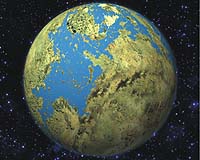
Milton Keynes, UK (SPX) Apr 05, 2005 How many planets like the Earth are there among the 130 or so known planetary systems beyond our own? How many of these "Earths" could be habitable? Recent theoretical work by Barrie Jones, Nick Sleep, and David Underwood at the Open University in Milton Keynes indicates that as many as half of the known systems could be harbouring habitable "Earths" today. Unfortunately, existing telescopes are not powerful enough to see these relatively small, distant "Earths". Orbiting close to a much brighter star, these very faint worlds resemble glow-worms hidden in the glare of a searchlight. All of the planets that have been detected so far are giants the mass of Neptune or larger. Even so, they cannot be directly seen with ground-based instruments. Almost all of the known exoplanets have been found through the "wobbling" motion they induce in their star as they orbit it, like a twirling dumb-bell in which the mass at one end (the star) is much greater than the mass at the other end (the giant planet). Speaking today at the RAS National Astronomy Meeting in Birmingham, Professor Jones explained how his team used computer models to see if "Earths" could be present in any of the currently known exoplanetary systems, and whether the gravitational buffeting from one or more giant planets in those systems would have torn them out of their orbits. "We were particularly interested in the possible survival of "Earths" in the habitable zone," said Professor Jones. "This is often called the 'Goldilocks zone,' where the temperature of an 'Earth' is just right for water to be liquid at its surface. If liquid water can exist, so could life as we know it." The Open University team created a mathematical model of a known exoplanetary system, with its star and giant planet(s), then launched an Earth-sized planet at some distance from the star to see if it survived. By detailed study of a few representative exoplanetary systems, they found that each giant planet is accompanied by two "disaster zones" - one exterior to the giant, and one interior. Within these zones, the giant�s gravity will cause a catastrophic change in the Earth-like planet�s orbit. The dramatic outcome is a collision with either the giant planet or the star, or ejection into the cold outer reaches of the system. The team found that the locations of these disaster zones depend not only on the mass of the giant planet (a well known result) but also on the eccentricity of its orbit. They thus established rules for determining the extent of the disaster zone. Having found the rules, they applied them to all of the known exoplanetary systems - a much quicker method than studying each system in detail. The range of distances from the star covered by its habitable zone was compared to the locations of the disaster zones to see if there was a full or partial safe haven for an Earth-like planet. They discovered that about half of the known exoplanetary systems offer a safe haven for a period extending from the present into the past that is at least long enough for life to have developed on any such planets. This assumes that "Earths" could have formed in the first place, which seems quite likely. However, the situation is complicated by the fact that the habitable zone migrates outwards as the star ages, and in some cases this changes the potential for life to evolve. Thus, in some cases a safe haven might have been available only in the past, while in other cases it might exist only in the future. These scenarios of past extinction and future birth increase to about two-thirds the proportion of the known exoplanetary systems that are potentially habitable at some time during the main-sequence lifetime of their central star. Related Links The Open University RAS The Extrasolar Planets Encyclopaedia SpaceDaily Search SpaceDaily Subscribe To SpaceDaily Express  In The Stars: Seeking Earth's Counterparts
 Washington (UPI) Apr 05, 2005
Gene Roddenberry's classic television series "Star Trek" was based on the premise the Milky Way galaxy held many planets that resembled Earth so closely they naturally gave rise to alien civilizations - the most famous being the Vulcans and Klingons. |
|
|

| The content herein, unless otherwise known to be public domain, are Copyright 1995-2006 - SpaceDaily.AFP and UPI Wire Stories are copyright Agence France-Presse and United Press International. ESA PortalReports are copyright European Space Agency. All NASA sourced material is public domain. Additionalcopyrights may apply in whole or part to other bona fide parties. Advertising does not imply endorsement,agreement or approval of any opinions, statements or information provided by SpaceDaily on any Web page published or hosted by SpaceDaily. Privacy Statement |