|
 |
 |
 |
 |
 |
 |
 |
 |
 |

| . |  |
. |
In The Stars: Seeking Earth's Counterparts
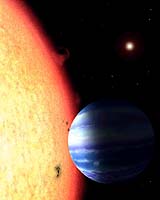
Washington (UPI) Apr 05, 2005 Gene Roddenberry's classic television series "Star Trek" was based on the premise the Milky Way galaxy held many planets that resembled Earth so closely they naturally gave rise to alien civilizations - the most famous being the Vulcans and Klingons. The problem for astronomers, exobiologists and interested lay people thus far is there has been no tangible evidence whatsoever that such planets exist, let alone extraterrestrial civilizations. It is a matter of distance and current technology. Even Alpha Centauri, the closest star to Earth at 4.3 light-years, is well beyond the capacity of telescopes to observe directly. The best instruments can do at the moment is gauge the wobble in the relative motion of neighboring stars caused by the gravitational tug of orbiting planets. Or, astronomers can precisely measure the light output of the stars to determine when they are being eclipsed by planets crossing between them and Earth. These techniques have produced strong evidence for about 130 extrasolar planets, including a few Earth-sized bodies orbiting the life-discouraging environs surrounding neutron stars - shrunken, highly energized remnants of supernovae. Despite a decade of such observations and discoveries, no one has yet been able to prove the existence of Earth-like planets - categorized as "Class M" in Starfleet Academy terminology. Now, however, there is at least a hint they are possible - and perhaps even commonplace. New computer models developed by a team at the Open University in Milton Keynes, England, suggests up to half of the 130-or-so known solar systems could be harboring habitable, Earth-like planets. Speaking at a meeting of the Royal Astronomy Society in Birmingham, England, Barrie Jones, an astronomy profess or, explained how his team employed the models to see if exo-Earths could survive within any of the currently known exoplanetary systems. The survival question is related to the same factors in play in our own solar system. It has to do with whether Earth - or any exo-Earth - can escape the gravitational grasp of one or more gas-giant planets in the solar system, a grasp that could tear it out of its orbit and send it careening either into cold, dark space or into a collision with the local sun. "We were particularly interested in the possible survival of 'Earths' in the habitable zone," Jones said. "This is often called the 'Goldilocks Zone,' where the temperature of an Earth is just right for water to be liquid at its surface. If liquid water can exist, so could life as we know it." Jones and his colleagues Nick Sleep and David Underwood created a mathematical model of several known exoplanetary systems, including th eir central star and gas-giant planets. Then they inserted an Earth-sized planet into each system at various distances from the star and from the giant planets to see what would happen. When they studied each system's planetary motion in detail, they found each giant planet is accompanied by two disaster zones - one toward the central star and one toward the outer planets. Within these zones, they said, the giant's gravity will cause a catastrophic change in the Earth-like planet's orbit - similar to what astronomers think happened to the planet that once occupied the orbit between Mars and Jupiter that now comprises the asteroid belt. One key discovery the team made was the locations of the disaster zones depended not only on the mass of the gas-giant, but also on the regularity - or lack thereof - of its orbit. This allowed them to set rules for determining the extent of the disaster zone. Jones and colleagues then applied those rules to all of the known exoplanetary systems, comparing the distances from each star covered by its habitable zone with the locations of the disaster zones to see if there was even a partial safe haven for an Earth-like planet. They discovered about half of the known systems offer a safe haven. Moreover, they calculated those safe havens - perhaps 65 of them - have existed long enough into the past that life could have developed on any exo-Earths orbiting inside them. The team's calculations even produced a bonus: Because habitable zones tend to migrate outward as a star ages, this means some of them might not exist until some time in the future. If so, there is a chance as many as two-thirds of the known exoplanetary systems might be potentially habitable at some time during the lifetime of their central star. In other words, just in the local neighborhood, there may be as many as 85 potential destinat ions for the Starship Enterprise - should we "live long and prosper" or enjoy "kapla." In the Stars is a series by UPI examining new discoveries about the cosmos. E-mail: [email protected] Related Links SpaceDaily Search SpaceDaily Subscribe To SpaceDaily Express  "Earths" Galore Await Discovery
 Milton Keynes, UK (SPX) Apr 05, 2005
How many planets like the Earth are there among the 130 or so known planetary systems beyond our own? How many of these "Earths" could be habitable? |
|
|

| The content herein, unless otherwise known to be public domain, are Copyright 1995-2006 - SpaceDaily.AFP and UPI Wire Stories are copyright Agence France-Presse and United Press International. ESA PortalReports are copyright European Space Agency. All NASA sourced material is public domain. Additionalcopyrights may apply in whole or part to other bona fide parties. Advertising does not imply endorsement,agreement or approval of any opinions, statements or information provided by SpaceDaily on any Web page published or hosted by SpaceDaily. Privacy Statement |