
 |
 |
 |
 |
 |
 |
 |
 |
 |
 |

| . |  |
. |

Durham NH (SPX) Dec 17, 2010 A team of scientists led by Marc Lessard of the University of New Hampshire Space Science Center launched an instrument-laden, four-stage sounding rocket from Norway's Andoya Rocket Range into aurora about 200 miles above Earth early Sunday morning (Dec. 12, 2010), just before the two-week launch window slammed shut. For the 10-minute flight, a 65-foot-long Black Brant XII rocket arced through a funnel-shaped region of Earth's magnetic field lines before landing some 900 miles downrange in the Norwegian Sea. The science data were transmitted to a ground station during the short flight. Funded by the National Aeronautics and Space Administration (NASA), the Rocket Experiment for Neutral Upwelling, or RENU, aimed to measure the complex, underlying physics behind the phenomena of "satellite drag. The launch required conditions that enhance the transfer of solar wind energy to Earth's magnetic field and, eventually, into our atmosphere to create the stunning northern lights or aurora. With the Sun becoming increasingly active after an unusually long quiet cycle, the researchers were banking that aurora would occur to allow a launch during the November 28 - December 12 window. Neutral upwelling has been known to exist since the earliest days of the space program when observers noted increased "drag" on Earth-orbiting satellites during periods of solar activity. At the time, the effect was largely attributed to a complex heating process that causes the upper part of the Earth's atmosphere, or thermosphere, to swell up horizontally on a scale of hundreds of kilometers. More recent observations have shown that neutral upwelling can also occur on much smaller scales and more localized in the cusp region - two "funnels" of magnetic field lines that allow a small amount of solar wind to reach the top of the atmosphere and produce the auroral glow. This upwelling process is more vertical in nature and appears to be associated with auroral processes. The RENU instrument payload was designed to take an array of measurements, including those for neutral gas, electric and magnetic fields, and precipitating particles, and the new data acquired during the flight will provide information essential for the advancement of understanding the process. The launch location in the far northern polar region was chosen so that the experiment could take place in total darkness. Although the effect of satellite drag can negatively impact a spacecraft's orbit over time, which is a concern for certain low-orbit, strategic satellites, Lessard stresses this was not the primary motivation for the experiment. "From NASA's point of view this is a mission of pure science, we're trying to understand the processes behind neutral upwelling and how it is associated with visible aurora phenomena," says Lessard, associate professor at the UNH Institute for the Study of Earth, Oceans, and Space (EOS) and department of physics. He adds that RENU is taking a new scientific approach and is attempting to test, measure, and quantify "electron precipitation" that brings energetic particles down from high above the Earth and delivers energy into the upper atmosphere via Earth's magnetic field lines. "This is the first time anyone has tried to measure these neutral particle enhancements at these altitudes and with this combination of instruments," Lessard says. He adds that it appears the team was successful in getting the rocket to transit a region of neutral density enhancement but because so much data is gathered during rocket launches (unlike satellites, vast amounts of data can be transmitted quickly back to Earth) it could take months to analyze the results. The team of investigators also includes colleagues from the Aerospace Corporation, Dartmouth College, Cornell University, the U.S. Air Force Academy, NASA's Goddard Space Flight Center, and other collaborators, including those at the Kjell Henriksen Observatory (KHO), which is operated by the University Center of Svalbard. An array of ground-based instrumentation located at KHO in the northernmost part of Norway complemented the rocket measurements. The data will be used to quantify neutral density enhancement, or regions of higher neutral atom density, and will also be used by theorists on the team to run mathematical models to gain insight into the heating and precipitation processes. Notes Lessard, "The instrumentation and science support provided from our colleagues at KHO has been invaluable."
Share This Article With Planet Earth
Related Links University of New Hampshire Solar Science News at SpaceDaily

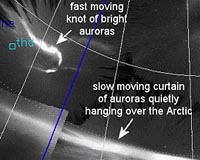 Colliding Auroras Produce Explosions Of Light
Huntsville AL (SPX) Dec 18, 2009 A network of cameras deployed around the Arctic in support of NASA's THEMIS mission has made a startling discovery about the Northern Lights. Sometimes, vast curtains of aurora borealis collide, producing spectacular outbursts of light. Movies of the phenomenon were unveiled at the Fall meeting of the American Geophysical Union in San Francisco. "Our jaws dropped when we saw the movies for ... read more |
|
|
| The content herein, unless otherwise known to be public domain, are Copyright 1995-2010 - SpaceDaily. AFP and UPI Wire Stories are copyright Agence France-Presse and United Press International. ESA Portal Reports are copyright European Space Agency. All NASA sourced material is public domain. Additional copyrights may apply in whole or part to other bona fide parties. Advertising does not imply endorsement,agreement or approval of any opinions, statements or information provided by SpaceDaily on any Web page published or hosted by SpaceDaily. Privacy Statement |


 del.icio.us
 Digg
Digg Reddit
 YahooMyWeb
 Google
 Facebook


