|
 |
 |
 |
 |
 |
 |
 |
 |
 |

| . |  |
. |
Five Giant Impact Basins Reveal The Ancient Equator Of Mars
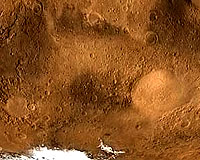
Washington DC (SPX) Apr 19, 2005 Since the time, billions of years ago, when Mars was formed, it has never been a spherically symmetric planet, nor is it composed of similar materials throughout, say scientists who have studied the planet. Since its formation, it has changed its shape, for example, through the development of the Tharsis bulge, an eight kilometer [five mile] high feature that covers one-sixth of the Martian surface, and through volcanic activity. As a result of these and other factors, its polar axis has not been stable relative to surface features and is known to have wandered through the eons as Mars rotated around it and revolved around the Sun. Now, a Canadian researcher has calculated the location of Mars' ancient poles, based upon the location of five giant impact basins on the planet's surface. Jafar Arkani-Hamed of McGill University in Montreal, Quebec, has determined that these five basins, named Argyre, Hellas, Isidis, Thaumasia, and Utopia, all lie along the arc of a great circle. This suggests that the projectiles that caused the basins originated with a single source and that the impacts trace the Martian equator at the time of impact, which was prior to the development of the Tharsis bulge, he says. Writing in the Journal of Geophysical Research (Planets), Arkani-Hamed calculates that the source of the five projectiles was an asteroid that had been circling the Sun in the same plane as Mars and most of the other planets. At one point, it passed close to the planet, until the force of Martian gravity surpassed the tensile strength of the asteroid, at which point it fragmented. The five large fragments would have remained in the same plane, that of Mars' then-equator. They hit in different spots around the Martian globe, due to Mars' rotation on its then-axis and the differing lengths of time the fragments took before impacting on Mars. Arkani-Hamed describes the locations of the resulting basins, only three of which are well preserved. The two others have been detected by analysis of Martian gravitational anomalies. The great circle they describe on the Martian surface has its center at latitude -30 and longitude 175. By realigning the map of Mars with that spot as the south pole, the great circle marks the ancient equator. Arkani-Hamed estimates that the mass of the asteroid captured by Mars was about one percent of that of Earth's Moon. Its diameter was in the range of 800 to 1,000 kilometers [500 to 600 miles], depending upon its density, which cannot be determined. The significance of Arkani-Hamed's findings, if borne out by further research, is that the extent of presumed underground water on Mars would have to be reassessed. "The region near the present equator was at the pole when running water most likely existed," he said in a statement. "As surface water diminished, the polar caps remained the main source of water that most likely penetrated to deeper strata and has remained as permafrost, underlain by a thick groundwater reservoir. This is important for future manned missions to Mars." Related Links McGill University American Geophysical Union SpaceDaily Search SpaceDaily Subscribe To SpaceDaily Express  Rich Zurek And The Mystery Of The Disappearing Spacecraft
 San Diego CA (SPX) Apr 18, 2005
Imagine if the illustrious Sherlock Holmes lived in modern times. He might decide to take on the challenge of solving the mysterious disappearance of the Beagle 2, a British spacecraft that vanished without a trace after entering the atmosphere of Mars on Christmas Day, 2003. |
|
|

| The content herein, unless otherwise known to be public domain, are Copyright 1995-2006 - SpaceDaily.AFP and UPI Wire Stories are copyright Agence France-Presse and United Press International. ESA PortalReports are copyright European Space Agency. All NASA sourced material is public domain. Additionalcopyrights may apply in whole or part to other bona fide parties. Advertising does not imply endorsement,agreement or approval of any opinions, statements or information provided by SpaceDaily on any Web page published or hosted by SpaceDaily. Privacy Statement |