|
 |
 |
 |
 |
 |
 |
 |

| . |  |
. |

|
|
. |

 by Staff Writers Berlin, Germany (SPX) Oct 18, 2011
An equation with four unknowns - at least, that is how satellite navigation is summarised by Walter Paffgen, Managing Director of the German Aerospace Center's Space Applications Company and Head of the Galileo Control Centre located at the DLR facility in Oberpfaffenhofen, near Munich. Three coordinates for spatial position and one for time. Taken together, these will give the position of a vehicle on Earth's surface in the new Galileo satellite navigation system. But for this equation to yield the correct result anywhere on Earth, a total of 30 satellites carrying highly accurate atomic clocks will be placed in orbit by 2018. The first two are due to be launched from Europe's Spaceport in French Guiana on 20 October 2011. "In order to achieve the desired accuracy, we need to measure the transit time of the signals with nanosecond precision, then use this to determine the distance between the satellite and the location on the ground," explains Paffgen. The Galileo signals travel to Earth at nearly the speed of light, or about 300,000 kilometres per second. If the measurements were only a microsecond out, there would be a 300-metre difference between the actual and the calculated position on the ground. Anyone wanting to consult their navigation device at a crossroad to check which way to turn would have some difficulties. "It is for this reason that we have the latest generation of atomic clocks on board the satellites," continues Paffgen. Every signal that the satellites send to Earth includes the very precise time of transmission, so that the transit time of the signal can be accurately calculated. To ensure that the clocks in all the satellites are keeping time correctly, the ground stations specify the time - the control centres supply the reference time that the Galileo satellites in space are synchronised with.
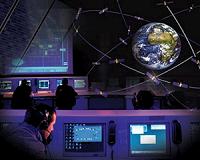
30 satellites to control The satellite launches and initial operations phases will be monitored alternately in Toulouse and Darmstadt; Oberpfaffenhofen will then take over operation of the satellites and Fucino will be responsible for processing the navigation data. According to Paffgen, this makes Galileo more accurate than the US GPS satellite navigation system. "Many applications will only be possible with this improved accuracy. Container trains are a good example of this," he says. When trains are running on adjacent tracks in a station, you cannot use just a fairly accurate positional calculation to allocate the correct track to a freight train. Even differences of a few metres make it impossible for the user of the navigation system to track their container during its journey. Shortly after the launch of the first two satellites, there will be a lot of work for DLR GfR. As the operator of the Galileo Control Centre under contract to the European Space Agency (ESA), DLR GfR will monitor the status of the satellites and the systems on board, as well as their orbits. Each satellite transmits some 20,000 pieces of data about its status back to Earth. In the future, when the 30 Galileo satellites are in orbit, a massive amount of data will be collected for analysis and assessment by engineers. In the case of an emergency - if a satellite is not functioning as it should - the engineers in Oberpfaffenhofen will need to intervene and correct the problem. "In the initial few months, we will be checking out the first two satellites very thoroughly," explains Paffgen. Systems must be prepared for power-up and every part of the satellites' payloads will undergo an extensive programme of tests.
Fit for space In addition, eight transmitting stations in the Alps have been used to simulate satellite signals coming from space for receivers in the Berchtesgaden region since February 2011. This has enabled developers to test their applications under 'real' conditions in the Galileo Test and Development Environment (Galileo Test- und Entwicklungsumgebung; GATE). The first opportunity for calculating a location based purely on Galileo satellite navigation data from space will come in August 2012, when two additional satellites will be sent into orbit. The first quartet will then be complete; position calculations are only possible with a minimum of four satellites. With 30 Galileo satellites and 24 GPS satellites - the two systems will be interoperable in the future - there will be an increased ability for users to receive signals from more than four satellites and thus be able to determine their position with greater accuracy. "Then, it will even be possible to receive an adequate satellite signal in narrow urban canyons, for example," says Paffgen. But one thing is essential to ensure that nobody using a mobile phone or a car will get lost in the city - the clocks in space must be accurately synchronised with the time provided by the control centres.
German Aerospace Center GPS Applications, Technology and Suppliers
|
. |
|
| The content herein, unless otherwise known to be public domain, are Copyright 1995-2011 - Space Media Network. AFP and UPI Wire Stories are copyright Agence France-Presse and United Press International. ESA Portal Reports are copyright European Space Agency. All NASA sourced material is public domain. Additional copyrights may apply in whole or part to other bona fide parties. Advertising does not imply endorsement,agreement or approval of any opinions, statements or information provided by Space Media Network on any Web page published or hosted by Space Media Network. Privacy Statement |

 del.icio.us
 Digg
Digg Reddit
 Google