|
 |
 |
 |
 |
 |
 |
 |
 |
 |

| . |  |
. |
Gold Nanoparticles May Simplify Cancer Detection
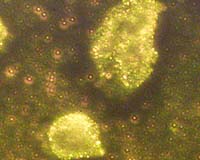
Atlanta GA (SPX) May 10, 2005 Binding gold nanoparticles to a specific antibody for cancer cells could make cancer detection much easier, suggests research at the Georgia Institute of Technology and the University of California at San Francisco (UCSF). The report is published online as an ASAP article in the journal Nano Letters. "Gold nanoparticles are very good at scattering and absorbing light," said Mostafa El-Sayed, director of the Laser Dyanamics Laboratory and chemistry professor at Georgia Tech. "We wanted to see if we could harness that scattering property in a living cell to make cancer detection easier. So far, the results are extremely promising." Many cancer cells have a protein, known as Epidermal Growth Factor Receptor (EFGR), all over their surface, while healthy cells typically do not express the protein as strongly. By conjugating, or binding, the gold nanoparticles to an antibody for EFGR, suitably named anti-EFGR, researchers were able to get the nanoparticles to attach themselves to the cancer cells. "If you add this conjugated nanoparticle solution to healthy cells and cancerous cells and you look at the image, you can tell with a simple microscope that the whole cancer cell is shining," said El-Sayed. "The healthy cell doesn�t bind to the nanoparticles specifically, so you don�t see where the cells are. With this technique, if you see a well defined cell glowing, that�s cancer." In the study, researchers found that the gold nanoparticles have 600 percent greater affinity for cancer cells than for noncancerous cells. The particles that worked the best were 35 nanometers in size. Researchers tested their technique using cell cultures of two different types of oral cancer and one nonmalignant cell line. The shape of the strong absorption spectrum of the gold nanoparticles are also found to distinguish between cancer cells and noncancerous cells. What makes this technique so promising, said El-Sayed, is that it doesn�t require expensive high-powered microscopes or lasers to view the results, as other techniques require. All it takes is a simple, inexpensive microscope and white light. Another benefit is that the results are instantaneous. "If you take cells from a cancer stricken tissue and spray them with these gold nanoparticles that have this antibody you can see the results immediately. The scattering is so strong that you can detect a single particle," said El-Sayed. Finally, the technique isn�t toxic to human cells. A similar technique using artificial atoms known as Quantum Dots uses semiconductor crystals to mark cancer cells, but the semiconductor material is potentially toxic to the cells and humans. "This technique is very simple and inexpensive to use," said El-Sayed. "We think it holds great promise in making cancer detection easier, faster and less expensive." The research team consisted of El-Sayed, along with his son Ivan El-Sayed, head and neck surgeon at the UCSF Comprehensive Cancer Center and Tech graduate student Xiaohua Huang. Related Links Mostafa El-Sayed SpaceDaily Search SpaceDaily Subscribe To SpaceDaily Express  PoliSci: Bills Aim To Ban, Protect Cloning
 Washington (UPI) April 25, 2005
A bill expected to be introduced this week will round out a quartet of congressional legislation laying bare the choice to either protect or ban human cloning for research and therapeutic medical purposes. |
|
|

| The content herein, unless otherwise known to be public domain, are Copyright 1995-2006 - SpaceDaily.AFP and UPI Wire Stories are copyright Agence France-Presse and United Press International. ESA PortalReports are copyright European Space Agency. All NASA sourced material is public domain. Additionalcopyrights may apply in whole or part to other bona fide parties. Advertising does not imply endorsement,agreement or approval of any opinions, statements or information provided by SpaceDaily on any Web page published or hosted by SpaceDaily. Privacy Statement |