|
 |
 |
 |
 |
 |
 |
 |
 |
 |

| . |  |
. |
Haleakala, Hawaii, Recommended For Advanced Technology Solar Telescope
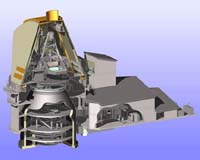
Maui HI (SPX) Oct 22, 2004 Haleakala atop Maui, Hawaii, was recommended as the future site of the world's largest optical solar telescope, with a final decision to be made in December based on logistical and other issues. The Science Working Group of the Advanced Technology Solar Telescope (ATST) project made the recommendation during a workshop in Tucson on Oct. 14, following the review of an additional year of site survey data from Haleakala and the two other candidate sites in California and the Canary Islands. The data were collected and analyzed by the Site Survey Working Group after the initial down selection from six sites to these three sites last year. If approved, the Haleakala site will be developed in conjunction with the University of Hawaii's Institute for Astronomy, which now operates the Mees Solar Observatory at the site on Maui, third largest of the Hawaiian Islands. The site is 3 km [10,023 ft] above sea level. "This site recommendation is a major step forward for ATST," said Dr. Stephen Keil, the ATST project director of the National Solar Observatory (NSO), which is leading the project. "However, the site selection is not yet finalized. The ATST co-principal investigators must review the scientific report and recommendations and discuss them with the National Science Foundation and the Association of Universities for Research in Astronomy, which provides management oversight for the NSO." "We are extremely excited that the Science Working Group has recognized the enormous scientific potential of Haleakala," said Dr. Rolf-Peter Kudritzki, director of the Institute for Astronomy (IfA) at the University of Hawaii. "Haleakala, 'the House of the Sun,' is a truly unique place, from a scientific viewpoint, as well as for its spiritual and cultural value to the Hawaiian people." The University of Hawaii first took interest in Haleakala for solar research in the mid 1950's and built the University's first observatory, the Mees Solar Observatory, in 1964. "Having the ATST come to Haleakala would be the next natural step in the evolution of solar research, to follow recent IfA advances in coronal observation and development of new infrared instrumentation for solar physics on Haleakala." "ATST will be the largest solar optical observatory and the world's leading resource for studying the magnetism that controls solar wind, solar flares and variability in the Sun's output," said Dr. Thomas Rimmele of NSO, the ATST project scientist at Sunspot. "The ATST will advance fundamental understanding of the star that most affects life on Earth." Some scientists have described the ATST as a "solar microscope" because of its ability to zoom in on fine-scale, short-lived features throughout the solar atmosphere, including the corona. ATST will have a 4-meter aperture employing state-of-the-art technology such as adaptive optics, which will let it achieve unprecedented spatial resolutions as fine as 0.03 arc-second (~20 km on the Sun). The extensive ATST site survey was designed to help select a site that will maximize the scientific productivity of the telescope. The desired daytime atmospheric characteristics of such a site are frequently clear skies, excellent seeing and low sky brightness, which is needed for observations of the faint corona. Low humidity, few aircraft contrails, and low dust levels are also of advantage. The initial ATST survey chose six sites as the best of an initial list of 72 potential sites: Haleakala, HI; La Palma, the Canary Islands, Spain; Big Bear Lake, CA; Sunspot, NM; Panguitch Lake, UT; and San Pedro Martir, Baja, Mexico. In late 2003, Haleakala, Big Bear, and La Palma were selected for further evaluation. "Each of the candidate sites has a unique combination of atmospheric conditions and other factors that would make it an outstanding location for the ATST," Rimmele stressed. "However, the survey data indicated a number of advantages that put Hawaii at the top of the list for final consideration for this particular project." ATST is a project of the solar physics research community, led by the NSO, the Association of Universities for Research in Astronomy (NSO's parent organization), and supported by the National Science Foundation. It has been highly ranked by the latest Decadal Survey of Astronomy and Astrophysics (2000) and a National Academy of Sciences study of ground-based solar astronomy. Related Links ATST SpaceDaily Search SpaceDaily Subscribe To SpaceDaily Express  Keck Interferometer team to make stars 'Disappear'
 Pasadena (JPL) Oct 22, 2004
The technological magicians at NASA's Jet Propulsion Laboratory and the W.M. Keck Observatory are a step closer to performing a vanishing act on a cosmic scale.
--------------------------------------------------------- It's new. And it's downright terrific! Celestron's CPC Schmidt-Cassegrain telescope is the scope you've been waiting for! It offers new alignment technology, advanced engineering, and bold new design at a new, low price! In fact, Celestron's Professional Computerized (CPC) scope with revolutionary SkyAlign Alignment Technology redefines everything that amateur astronomers are looking for. It offers quick and simple alignment, GPS technology, unsurpassed optical quality, ease of use, advanced ergonomics, enhanced computerization and, most important, affordability. Want to view M-31 tonight? One button takes you there!
Shop for telescopes online at Telescopes.com! today!
|
|
|

| The content herein, unless otherwise known to be public domain, are Copyright 1995-2006 - SpaceDaily.AFP and UPI Wire Stories are copyright Agence France-Presse and United Press International. ESA PortalReports are copyright European Space Agency. All NASA sourced material is public domain. Additionalcopyrights may apply in whole or part to other bona fide parties. Advertising does not imply endorsement,agreement or approval of any opinions, statements or information provided by SpaceDaily on any Web page published or hosted by SpaceDaily. Privacy Statement |