
 |
 |
 |
 |
 |
 |
 |
 |
 |
 |

| . |  |
. |

Rome, Italy (SPX) Sep 24, 2010 The heat in the atmosphere of Venus, induced from a strong greenhouse warming, might actually have a cooling effect on the planet's interior. This counter-intuitive theory is based on calculations from a new model presented at the European Planetary Science Congress (EPSC) in Rome on Tuesday 21st September. "For some decades we've known that the large amount of greenhouse gases in the atmosphere of Venus cause the extreme heat we observe presently," explains Lena Noack from the German Aerospace Center (DLR) in Berlin, lead author of the study. "The carbon dioxide and other greenhouse gases that are responsible for the high temperatures were blown into the atmosphere by thousands of volcanoes in the past. The permanent heat - today we measure almost 470 degrees Celsius globally on Venus - might even have been much higher in the past and, in a runaway cycle, led to even more volcanism. But at a certain point this process turned on its head - the high temperatures caused a partial mobilization of the Venusian crust, leading to an efficient cooling of the mantle, and the volcanism strongly decreased. This resulted in lower surface temperatures, rather comparable to today's temperature on Venus, and the mobilization of the surface stopped." The source of the magma, or molten rocky material, and the volcanic gases lies deep in the mantle of Venus. The decay of radioactive elements, inherited from the building blocks of the Solar System's planets, and the heat stored in the interior from planet formation produce enough heat to generate partial melts of silicate-, iron- and magnesium-rich magma in the upper mantle. Molten rock has more volume and is lighter than the surrounding solid rock of identical composition. The magma therefore can rise upwards and eventually penetrate through the rigid crust in volcanic vents, spreading lava over the surface and blowing gases into the atmosphere, mostly greenhouse gases like carbon dioxide (CO2), water vapor (H2O) and sulphur dioxide (SO2). However, the more greenhouse gases, the hotter the atmosphere - possibly leading to even more volcanism. To find out if this runaway process would end in a red-hot Venus, Lena Noack and Doris Breuer, co-author of the study, calculated for the first time a model where the hot atmosphere is 'coupled' to a 3D model of the planet's interior. Unlike here on Earth, the high temperatures have a much bigger effect at the interface with the rocky surface, heating it up to a large extent. "Interestingly, due to the rising surface temperatures, the surface is mobilized and the insulating effect of the crust diminishes," says Noack. "The mantle of Venus loses much of its thermal energy to the outside. It's a little bit like lifting the lid on the mantle: the interior of Venus suddenly cools very efficiently and the rate of volcanism ceases. Our model shows that after that 'hot' era of volcanism, the slow-down of volcanism leads to a strong decrease of the temperatures in the atmosphere." The calculations of the geophysicists yield another interesting result: the process of volcanic resurfacing takes place at different places at different times. When the atmosphere cools, the mobilization of the surface stops. However, there are still a few active volcanoes which resurface some spots with lava flows. Some volcanoes might be active even today, which fits recent results from the European Space Agency's Venus Express mission. This detected 'hot spots', or unusual high surface temperatures at volcanoes previously thought to be extinct. So far no 'smoking gun', or active volcano has been identified on Venus - but it seems not unlikely that Venus Express or future space probes will detect the first active volcano on Earth's next neighbor.
Share This Article With Planet Earth
Related Links EPSC 2010 Venus Express News and Venusian Science

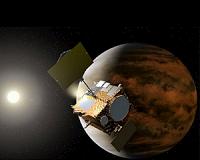 Japanese Spacecraft Approaches Venus
Huntsville AL (SPX) Aug 17, 2010 For the next few months, Venus will be softly resplendent in the evening sky, a treat for stargazers - but looks can be deceiving. Consider this: The Venusian surface is hot enough to melt lead. The planet's 96% carbon dioxide atmosphere is thick and steamy with a corrosive mist of sulfuric acid floating through it. The terrain is forbidding, strewn with craters and volcanic calderas - and bone ... read more |
|
|
| The content herein, unless otherwise known to be public domain, are Copyright 1995-2010 - SpaceDaily. AFP and UPI Wire Stories are copyright Agence France-Presse and United Press International. ESA Portal Reports are copyright European Space Agency. All NASA sourced material is public domain. Additional copyrights may apply in whole or part to other bona fide parties. Advertising does not imply endorsement,agreement or approval of any opinions, statements or information provided by SpaceDaily on any Web page published or hosted by SpaceDaily. Privacy Statement |


 del.icio.us
 Digg
Digg Reddit
 YahooMyWeb
 Google
 Facebook


