
 |
The massive sunspot, which astronomers say is the size of Jupiter, is the strongest solar flare in four years, NASA said Wednesday.
The Class X flash -- the largest such category -- erupted at 0156 GMT Tuesday, according to the US space agency.
"X-class flares are the most powerful of all solar events that can trigger radio blackouts and long-lasting radiation storms," disturbing telecommunications and electric grids, NASA said.
NASA's Solar Dynamics Observatory saw a large coronal mass ejection (CME) associated with the flash that is blasting toward Earth at about 560 miles per second (900 kilometers per second), it said.
The charged plasma particles were expected to reach the planet's orbit at 0300 GMT Thursday.
The flare spread from Active Region 1158 in the sun's southern hemisphere, which had so far lagged behind the northern hemisphere in flash activity. It followed several smaller flares in recent days.
"The calm before the storm," read a statement on the US National Weather Service Space Weather Prediction Service.
"Three CMEs are enroute, all a part of the Radio Blackout events on February 13, 14, and 15 (UTC). The last of the three seems to be the fastest and may catch both of the forerunners about mid to late ... February 17."
Geomagnetic storms usually last 24 to 48 hours, "but some may last for many days," read a separate NWS statement.
"Ground to air, ship to shore, shortwave broadcast and amateur radio are vulnerable to disruption during geomagnetic storms. Navigation systems like GPS can also be adversely affected."
The China Meteorological Administration reported that the solar flare had jammed shortwave radio communications in southern China.
It said the flare caused "sudden ionospheric disturbances" in the atmosphere above China, and warned there was a high probability that large solar flares would appear over the next three days, the official Xinhua news agency reported.
In previous major disturbance of the Earth's electric grid from a solar incident, in 1973, a magnetic storm caused by a solar eruption plunged six million people into darkness in Canada's eastern-central Quebec province.
The British Geological Survey (BGS) said meanwhile that the solar storm would result in spectacular Northern Lights displays starting Thursday.
One coronal mass ejection (CME) arrived on February 14, "sparking Valentine's Day displays of the Northern Lights (aurora borealis) further south than usual."
"Two CMEs are expected to arrive in the next 24-48 hours and further... displays are possible some time over the next two nights if skies are clear," it said.
The office published geomagnetic records dating back to the Victorian era which it hopes will help in planning for future storms.
"Life increasingly depends on technologies that didn't exist when the magnetic recordings began," said Alan Thomson, BGS head of geomagnetism.
"Studying the records will tell us what we have to plan and prepare for to make sure systems can resist solar storms," he said.
 del.icio.us del.icio.us |
 Digg Digg |
 Reddit Reddit |
 YahooMyWeb YahooMyWeb |
 Google Google |
 Facebook Facebook |

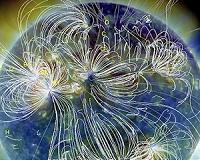 SDO Celebrates One Year Anniversary
| The content herein, unless otherwise known to be public domain, are Copyright 1995-2010 - SpaceDaily. AFP and UPI Wire Stories are copyright Agence France-Presse and United Press International. ESA Portal Reports are copyright European Space Agency. All NASA sourced material is public domain. Additional copyrights may apply in whole or part to other bona fide parties. Advertising does not imply endorsement,agreement or approval of any opinions, statements or information provided by SpaceDaily on any Web page published or hosted by SpaceDaily. Privacy Statement |


