|
 |
 |
 |
 |
 |
 |
 |
 |
 |

| . |  |
. |
ISS Crew Breathe Easy
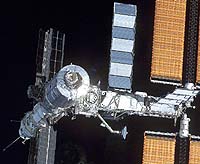
Washington - Mar 29, 2004 The oxygen-producing Elektron unit aboard the Space Station continues to function well, as it has since it was restarted early last Saturday. Expedition 8 Commander Michael Foale and Flight Engineer Alexander Kaleri spent two days last week replacing a liquids unit and a water flow system of the Russian Elektron, in the Zvezda Service Module. The Elektron separates water into oxygen and hydrogen. The oxygen is used in the Station's atmosphere, while the hydrogen is vented over board. The Elektron had shut down repeatedly after only brief periods of operation during the past several weeks. In the meantime, the crew used oxygen and air from the Progress cargo vehicle docked at the Station to replenish the atmosphere, as well as Solid Fuel Oxygen Generation (SFOG) canisters. Each canister can supply the oxygen needs of one crewmember for one day. Thirteen SFOGs were used during the week before the Elektron was repaired and activated. More than 100 SFOGs remain on board, and two high-pressure tanks on the Station's Quest airlock contain a supply of oxygen that could last several months if needed. With the Elektron running smoothly, Foale and Kaleri devoted much of the week to science activities. Kaleri tended the Rasteniya experiment, a greenhouse containing peas, designed to see how plants grow in a microgravity environment. Kaleri also did a test of the Russian TORU manual docking system, using the Station Progress 13 vehicle docked to Zvezda. That Progress will be undocked, and it will burn up in the Earth's atmosphere in mid-May, the day before a new Progress arrives with about two-and-a-half tons of equipment, supplies, water and fuel. Foale worked with the Miscible Fluids in Microgravity (MFMG) experiment. It involves injecting honey into a water container to see how the two combine in weightlessness. He also worked with the Pore Formation and Mobility Investigation, melting a transparent material in the Microgravity Science Glovebox to observe the formation and interaction of bubbles in the material. The experiment could help in prevention of bubble formation during such processes, perhaps resulting in stronger materials. Foale also set up the hardware for the Binary Colloidal Alloy Test 3 (BCAT-3) experiment. BCAT-3 studies the behavior of tiny particles suspended in fluid. On Earth, gravity causes colloids to separate, causing sedimentation. The Station's microgravity environment gives researchers a chance to study the complex fluids without this effect. On Monday and Tuesday, both crewmembers wore acoustic dosimeters for about eight hours as part of regularly scheduled tests of the Station's noise levels. For the last half of both days, they removed the dosimeters and set them up in stationary locations. The following day Foale and Kaleri did a periodic, detailed inspection of one of two U.S. spacesuits on the Station. The other is not scheduled for inspection for several months. Related Links Sicence at ISS SpaceDaily Search SpaceDaily Subscribe To SpaceDaily Express  The Slowest And Fastest Train In The Universe
 Houston - Mar 26, 2004
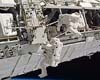
The Mobile Transporter is the slowest and fastest train in the universe, at the same time. How can that be? It's all in the details. |
|
|

| The content herein, unless otherwise known to be public domain, are Copyright 1995-2006 - SpaceDaily.AFP and UPI Wire Stories are copyright Agence France-Presse and United Press International. ESA PortalReports are copyright European Space Agency. All NASA sourced material is public domain. Additionalcopyrights may apply in whole or part to other bona fide parties. Advertising does not imply endorsement,agreement or approval of any opinions, statements or information provided by SpaceDaily on any Web page published or hosted by SpaceDaily. Privacy Statement |