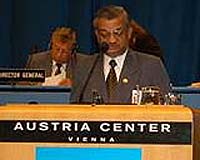
India's Atomic Energy Chairman Anil Kakodkar.
India's Atomic Energy Chairman Anil Kakodkar. |
It also allows India to reprocess spent fuel under safeguards imposed by the International Atomic Energy Agency, going one step further than a law passed by the US Congress in December.
"We have got a very good deal which should meet requirements of both the countries," said India's Atomic Energy Chairman Anil Kakodkar, previously one of the toughest critics of the nuclear accord.
"You give some and you get some and we are satisfied with this," Kakodkar said.
The nuclear energy deal is the centrepiece of India's new relationship with Washington after decades of Cold War tensions and is part of New Delhi's efforts to expand energy sources to sustain its booming economy.
Leaders of India's ruling Congress party were slated to meet late on Saturday to discuss the pact, which must be passed by parliament and the US Congress before it can be implemented.
The text of the agreement, which has been struck even though India has refused to sign non-proliferation treaties, has not yet been made public.
Some key US legislators, however, were sceptical about the pact, amid concern the terms would weaken Washington's non-proliferation goals.
Responding to domestic fears expressed earlier that the agreement could cap India's military capabilities, Kakodkar said that the country's nuclear programme would be unaffected by the deal.
Indian national security advisor M.K. Narayanan also praised the agreement, which took two years to complete, calling it "as good a text as one can possibly get."
The right to reprocess spent US-sourced nuclear fuel has been given only to Japan and the European Union so far, and US lawmakers have expressed doubt about safeguards needed to deter India from possibly diverting any nuclear material to its military weapons program.
But Narayanan said the deal was not an opportunity for India to increase its nuclear arsenal.
"I think it's time certain countries overcame the belief that we are interested in proliferation," Narayanan said.
Under the accord, India is to separate nuclear facilities for civilian and military use and set up a regime of international inspections in return for technology and nuclear fuel supplies.
Strategic expert Kapil Kak called the agreement a "lucky break" for India and said it was a result of tough negotiations that began a little after the two countries in March 2005 agreed on civilian nuclear cooperation.
"India negotiated hard with a well-calibrated diplomatic approach to global sensitivities which resulted in this lucky break," said Kak, director of the Centre for Strategic Studies think-tank.
Community
 US And India Adopt Historic Nuclear Agreement
 Washington (AFP) Jul 27, 2007
| The content herein, unless otherwise known to be public domain, are Copyright 1995-2006 - SpaceDaily.AFP and UPI Wire Stories are copyright Agence France-Presse and United Press International. ESA PortalReports are copyright European Space Agency. All NASA sourced material is public domain. Additionalcopyrights may apply in whole or part to other bona fide parties. Advertising does not imply endorsement,agreement or approval of any opinions, statements or information provided by SpaceDaily on any Web page published or hosted by SpaceDaily. Privacy Statement |