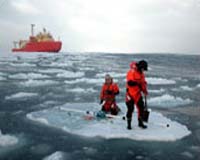
New permanent waterways and ice free lands will have a major strategic impact on the Arctic its surrounding powers.
New permanent waterways and ice free lands will have a major strategic impact on the Arctic its surrounding powers. |
But while this may well be true for today, the stage has been quietly set for a much more serious confrontation in the not too distant future between Russia and the United States -- along with Canada, Norway and Denmark.
Russia has recently laid claim to a vast 460,800 square-mile chunk of the ice-covered Arctic seabed. The claim is not really about territory, but rather about the huge hydrocarbon reserves that are hidden on the seabed under the Arctic ice cap. These newly discovered energy reserves will play a crucial role in the global energy balance as the existing reserves of oil and gas are depleted over the next 20 years.
Russia has the world's largest gas reserves and is the second largest exporter of oil after Saudi Arabia, but its oil and gas production is slated to decline after 2010 as currently operational reserves dwindle. Russia's Natural Resources Ministry estimates that the country's existing oil reserves will be depleted by 2030.
The 2005 British Petroleum World Energy Survey projects that U.S. oil reserves will last another 10 years if the Arctic National Wildlife Refuge is not opened for oil exploration; Norway's reserves are good for about seven years and British North Sea reserves will last no more than five years -- which is why the Arctic reserves, which are still largely unexplored, will be of such crucial importance to the world's energy future.
Scientists estimate that the territory contains more than 10 billion tons of gas and oil deposits. The shelf is about 200 meters, or 650 feet, deep and the challenges of extracting oil and gas there appear to be surmountable, particularly if the oil prices stay where they are now -- over $70 a barrel.
The Kremlin wants to secure Russia's long-term dominance over global energy markets. To ensure this, Russia needs to find new sources of fuel and the Arctic seems like the only place left to go. But there is a problem: International law does not recognize Russia's right to the entire Arctic seabed north of the Russian coastline.
The 1982 International Convention on the Law of the Sea establishes a 12-mile zone for territorial waters and a larger 200 mile economic zone in which a country has exclusive drilling rights for hydrocarbon and other resources.
Russia claims that the entire swath of Arctic seabed in the triangle that ends at the North Pole belongs to Russia, but the U.N. committee that administers the Law of the Sea Convention has so far refused to recognize Russia's claim to the entire Arctic seabed.
Next: Where Russia and the United States differ on the Arctic
(Vladimir Frolov is the director of the National Laboratory for Foreign Policy, a Moscow-based think tank.
Community
 Russia Proposes Drafting Simpler START Arms Treaty
 Moscow (RIA Novosti) Jul 23, 2007
| The content herein, unless otherwise known to be public domain, are Copyright 1995-2006 - SpaceDaily.AFP and UPI Wire Stories are copyright Agence France-Presse and United Press International. ESA PortalReports are copyright European Space Agency. All NASA sourced material is public domain. Additionalcopyrights may apply in whole or part to other bona fide parties. Advertising does not imply endorsement,agreement or approval of any opinions, statements or information provided by SpaceDaily on any Web page published or hosted by SpaceDaily. Privacy Statement |