|
 |
 |
 |
 |
 |
 |
 |
 |
 |

| . |  |
. |
Japanese Space Observatory To Carry NASA X-RAY Instrument
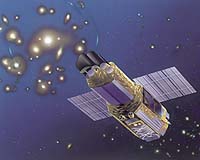
Greenbelt MD (SPX) Jul 01, 2005 A pioneering X-ray detector developed at NASA'S Goddard Space Flight Center will launch on board the new Astro-E2 space observatory. Astro-E2's primary instrument is the high-resolution X-ray Spectrometer (XRS), developed jointly by GSFC and the Japan Aerospace Exploration Agency (JAXA) Institute of Space and Astronautical Science (ISAS). The XRS measures the heat created by the individual X-ray photons (light particles) it collects. To sense the heat of a single photon, the XRS detector must be cooled to an extremely low temperature, approximately - 460 degrees Fahrenheit. The coldest reaches of space are approximately -454 degrees Fahrenheit. This will make the XRS colder than space. Using this new technique, scientists can measure higher X-ray energies with a precision about ten times greater than with previous sensors. "Astro-E2 will showcase an entirely new technology that will not only serve as a test bed for future missions but produce some spectacular science to boot," said Dr. Anne Kinney, director of the Universe Division in NASA's Science Mission Directorate. "This is the highly anticipated complement to NASA's Chandra X-ray Observatory and Europe's XMM-Newton. Scientists around the world eagerly await the launch," she added. Astro-E2 was developed at JAXA's ISAS in collaboration with U. S. scientists and other Japanese institutions. The mission will contain three X-ray instruments. Scientists will use these to study phenomena that radiate predominantly in X- rays. Astro-E2 will study black holes and the creation of chemical elements necessary for life. Key targets include hot gas falling toward black holes; the million-degree ejecta of star explosions filled with newly minted elements such as oxygen and calcium; and the optically invisible gas between stars and galaxies, which comprise most of the ordinary mass in the universe. "Incoming light particles will raise the temperature of the detector by only a few thousandths of a degree," said Dr. Richard Kelley, Principal Investigator for the U.S. contribution to Astro-E2. "Knowing the precise energy that these light particles carry, we can infer new information about their origins," he added. Along with the XRS are four X-ray Imaging Spectrometer (XIS) instruments, a collaboration among Japanese institutions and the Massachusetts Institute of Technology; and the Hard X- Ray Detector (HXD), built by the University of Tokyo, ISAS and other Japanese institutions. The XRS and XIS instruments will analyze X-ray photons focused by individual telescopes, built at GSFC by a team led by Dr. Peter Serlemitsos. The HXD also uses a tested and improved technology. Astro-E2 will be launched on an M-V rocket and will attain a near-Earth circular orbit at approximately 353.4 miles. The observatory's expected mission lifetime is five years. The observatory will launch July 6 from Japan's Uchinoura Space Center. With its official name to be bestowed after deployment, Astro-E2 is the fifth in a series of Japanese satellites devoted to studying celestial X-ray sources. Previous missions are Hakucho, Tenma, Ginga, and ASCA. Related Links ISAS and JAXA Astro-E2 SpaceDaily Search SpaceDaily Subscribe To SpaceDaily Express  How One Night In A Field Changed Astronomy
 Washington DC (SPX) Jun 30, 2005
Fifty years ago, scientists Bernard Burke and Kenneth Franklin mistook radio signals from Jupiter for a Maryland farmhand driving home after a late date. |
|
|

| The content herein, unless otherwise known to be public domain, are Copyright 1995-2006 - SpaceDaily.AFP and UPI Wire Stories are copyright Agence France-Presse and United Press International. ESA PortalReports are copyright European Space Agency. All NASA sourced material is public domain. Additionalcopyrights may apply in whole or part to other bona fide parties. Advertising does not imply endorsement,agreement or approval of any opinions, statements or information provided by SpaceDaily on any Web page published or hosted by SpaceDaily. Privacy Statement |