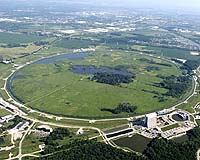
disclaimer: image is for illustration purposes only
disclaimer: image is for illustration purposes only |
When completed this summer, the LHC will be the world's largest and most complex scientific instrument. It is being constructed by the European Organization for Nuclear Research, one of the world's largest particle physics laboratories.
Workers this week began lowering the Compact Muon Solenoid, or CMS, detector into the underground facility. Muons are fundamental elements of matter.
The CMS detector, designed and built by more than 2,500 scientists and engineers from 39 nations, will help investigate the fundamental nature of particles and explore dark matter -- matter that can't be directly observed, but comprises most matter in the universe.
"This is a very exciting time for physics," said CMS spokesman Tejinder Virdee. "The LHC is poised to take us to a new level of understanding of our universe."
Community
 New Discovery On Magnetic Reconnection To Impact Future Space Missions
 Paris, France (ESA) Jan 24, 2008
| The content herein, unless otherwise known to be public domain, are Copyright 1995-2007 - SpaceDaily.AFP and UPI Wire Stories are copyright Agence France-Presse and United Press International. ESA Portal Reports are copyright European Space Agency. All NASA sourced material is public domain. Additional copyrights may apply in whole or part to other bona fide parties. Advertising does not imply endorsement,agreement or approval of any opinions, statements or information provided by SpaceDaily on any Web page published or hosted by SpaceDaily. Privacy Statement |