
 |
 |
 |
 |
 |
 |
 |
 |
 |
 |

| . |  |
. |
Latest LISA Pathfinder Hardware Is A Little Gem
Paris, France (SPX) Nov 24, 2008 A stunning sapphire and gold casket is the latest addition to the LISA Pathfinder flight hardware collection. Designed to house the LISA Technology Package proof masses the casket is now undergoing experiment characterisation tests in Italy.
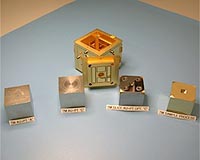
The 'precious' core of the LTP The proof mass is a cube of 46 mm on a side, weighing about 1.96 kg, and made from a special alloy of approximately 73% gold and 27% platinum (see Figure 2). This alloy has been specifically chosen in order to minimise the susceptibility of the material to external magnetic fields. In order to fulfil its experimental role the proof mass must not be perturbed by magnetic fields generated by the spacecraft electrical units or those intrinsic to interplanetary space. The proof masses are in many senses the 'precious' core of LISA Pathfinder, as they are the material bodies that will follow a pure free-fall trajectory during the mission. They will also be the gravitational wave sensors in the LISA spacecraft.
Sapphire and gold caskets for the precious proof masses On 4 November the first flight-like EH was delivered by its manufacturer, Thales Alenia Space Italy of Milan (formerly Laben), to the University of Trento, Italy, for experiment characterisation tests. During these tests, a "torsional pendulum" is used to reproduce, in two degrees of freedom, nearly the same conditions of free-fall that will be experienced by LISA Pathfinder. Measurements will be made using the pendulum, to check that when the proof mass is inside the electrodes housing it behaves as expected in terms of coupling with the EH, and also to check that the EH is without defects. The EH, a cube measuring about 70 mm on a side, contains the proof mass with a gap of only 4 mm. This gap allows the proof mass to float inside the EH once LISA Pathfinder is in space. On each of the six sides of the box, sapphire electrodes, especially manufactured by Kyburz-Sapphire in Switzerland, will be used to create an electrostatic field across the proof mass in order to sense its position with high accuracy in all directions (2 nm/sqrt Hz). The electrodes also provide electrostatic forces which will gently maintain the cube in the centre of the EH during the experiment.
A challenging manufacturing process + accurately polished to a roughness not exceeding 2 microns, + coated with a layer of Manganese, + their edges accurately chamfered, + the faces marked with a small Laser cross for alignment, + 3D precision measured, + coated with a layer of Rhodium and Titanium, + brazed on Molybdenum frames, + and finally, assembled with a special quartz mandrel and adjusting pins. All of the parts are first assembled to check that everything fits correctly; they are then disassembled, the electrodes finally coated with gold, the special connector pins inserted and the EH is then reassembled again. One of the sides is left unmounted to allow for the insertion of the proof mass at a later date. The manufacturing process has required the box parts to travel across Europe to specialised laboratories and workshops in Switzerland, Germany and Italy. Not only does the final product comply to specifications, it is also beautiful - a stunning addition to the LISA Pathfinder hardware collection. Share This Article With Planet Earth
Related Links LISA Pathfinder Understanding Time and Space
 Physicists Create BlackMax To Search For Dimensions In Space At The LHC
 Cleveland OH (SPX) Nov 10, 2008
A team of theoretical and experimental physicists, with participants from Case Western Reserve University, have designed a new black hole simulator called BlackMax to search for evidence that extra dimensions might exist in the universe. |
|
|

| The content herein, unless otherwise known to be public domain, are Copyright 1995-2007 - SpaceDaily.AFP and UPI Wire Stories are copyright Agence France-Presse and United Press International. ESA Portal Reports are copyright European Space Agency. All NASA sourced material is public domain. Additional copyrights may apply in whole or part to other bona fide parties. Advertising does not imply endorsement,agreement or approval of any opinions, statements or information provided by SpaceDaily on any Web page published or hosted by SpaceDaily. Privacy Statement |
 del.icio.us
 Digg
Digg Reddit
 YahooMyWeb
 Google
 Facebook