
 |
 |
 |
 |
 |
 |
 |
 |
 |
 |

| . |  |
. |

Bethlehem PA (SPX) Mar 16, 2011 A team of electrical engineers and chemists at Lehigh University have experimentally verified the "rainbow" trapping effect, demonstrating that plasmonic structures can slow down light waves over a broad range of wavelengths. The idea that a rainbow of broadband light could be slowed down or stopped using plasmonic structures has only recently been predicted in theoretical studies of metamaterials. The Lehigh experiment employed focused ion beams to mill a series of increasingly deeper, nanosized grooves into a thin sheet of silver. By focusing light along this plasmonic structure, this series of grooves or nano-gratings slowed each wavelength of optical light, essentially capturing each individual color of the visible spectrum at different points along the grating. The findings hold promise for improved data storage, optical data processing, solar cells, bio sensors and other technologies. While the notion of slowing light or trapping a rainbow sounds like ad speak, finding practical ways to control photons-the particles that makes up light- could significantly improve the capacity of data storage systems and speed the processing of optical data. The research required the ability to engineer a metallic surface to produce nanoscale periodic gratings with varying groove depths. This alters the optical properties of the nanopatterned metallic surface, called Surface Dispersion Engineering. The broadband surface light waves are then trapped along this plasmonic metallic surface with each wavelength trapped at a different groove depth, resulting in a trapped rainbow of light. Through direct optical measurements, the team showed that light of different wavelengths in the 500-700nm region was "trapped" at different positions along the grating, consistent with computer simulations. To prepare the nanopattern gratings required "milling" 150nm wide rectangular grooves every 520nm along the surface of a 300-nm-thick silver sheet. While intrinsic metal loss on the surface of the metal did not permit the complete "stopping" of these plasmons, future research may look into compensating this loss in an effort to stop light altogether. "Metamaterials, which are man-made materials with feature sizes smaller than the wavelength of light, offer novel applications in nanophotonics, photovoltaic devices, and biosensors on a chip," said Filbert J. Bartoli, principal investigator, professor and chair of the Department of Electrical and Computer Engineering. "Creating such nanoscale patterns on a metal film allows us to control and manipulate light propogation. The findings of this paper present an unambiguous experimental demonstration of rainbow trapping in plasmonic nanostructures, and represents an important step in this direction." "This technology for slowing light at room temperature can be integrated with other materials and components, which could lead to novel platforms for optical circuits. "The ability of surface plasmons to concentrate light within nanoscale dimensions makes them very promising for the development of biosensors on chip and the study of nonlinear optical interactions," said Qiaoqiang Gan, who completed this work while a doctoral candidate at Lehigh University, and is now an assistant professor in the Department of Electrical Engineering , State University of New York at Buffalo. The study was conducted by Bartoli, Qiaoqiang Gan, Yongkang Gao and Yujie J. Ding of the Center for Optical Technologies in the Department of Electrical and Computer Engineering at Lehigh University; and Kyle Wagner and Dmitri V. Vezenov of the Department of Chemistry at Lehigh. The study was funded by the National Science Foundation. It is published in the current issue of the Proceedings of the National Academy of Sciences.
Share This Article With Planet Earth
Related Links Lehigh University Nano Technology News From SpaceMart.com Computer Chip Architecture, Technology and Manufacture

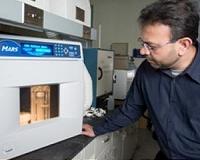 NJIT Prof Offers New Desalination Process Using Carbon Nanotubes
Newark NJ (SPX) Mar 16, 2011 A faster, better and cheaper desalination process enhanced by carbon nanotubes has been developed by NJIT Professor Somenath Mitra. The process creates a unique new architecture for the membrane distillation process by immobilizing carbon nanotubes in the membrane pores. Conventional approaches to desalination are thermal distillation and reverse osmosis. "Unfortunately the current membran ... read more |
|
|
| The content herein, unless otherwise known to be public domain, are Copyright 1995-2010 - SpaceDaily. AFP and UPI Wire Stories are copyright Agence France-Presse and United Press International. ESA Portal Reports are copyright European Space Agency. All NASA sourced material is public domain. Additional copyrights may apply in whole or part to other bona fide parties. Advertising does not imply endorsement,agreement or approval of any opinions, statements or information provided by SpaceDaily on any Web page published or hosted by SpaceDaily. Privacy Statement |


 del.icio.us
 Digg
Digg Reddit
 YahooMyWeb
 Google
 Facebook


