
 |
 |
 |
 |
 |
 |
 |
 |
 |
 |

| . |  |
. |

Paris, France (SPX) Dec 17, 2010 Gamma-ray bursts are among the most energetic events in the Universe, but some appear curiously faint in visible light. The biggest study to date of these so-called dark gamma-ray bursts, using the GROND instrument on the 2.2-metre MPG/ESO telescope at La Silla in Chile, has found that these gigantic explosions don't require exotic explanations. Their faintness is now fully explained by a combination of causes, the most important of which is the presence of dust between the Earth and the explosion. Gamma-ray bursts (GRBs), fleeting events that last from less than a second to several minutes, are detected by orbiting observatories that can pick up their high energy radiation. Thirteen years ago, however, astronomers discovered a longer-lasting stream of less energetic radiation coming from these violent outbursts, which can last for weeks or even years after the initial explosion. Astronomers call this the burst's afterglow. While all gamma-ray bursts have afterglows that give off X-rays, only about half of them were found to give off visible light, with the rest remaining mysteriously dark. Some astronomers suspected that these dark afterglows could be examples of a whole new class of gamma-ray bursts, while others thought that they might all be at very great distances. Previous studies had suggested that obscuring dust between the burst and us might also explain why they were so dim. "Studying afterglows is vital to further our understanding of the objects that become gamma-ray bursts and what they tell us about star formation in the early Universe," says the study's lead author Jochen Greiner from the Max-Planck Institute for Extraterrestrial Physics in Garching bei Munchen, Germany. NASA launched the Swift satellite at the end of 2004. From its orbit above the Earth's atmosphere it can detect gamma-ray bursts and immediately relay their positions to other observatories so that the afterglows could be studied. In the new study, astronomers combined Swift data with new observations made using GROND - a dedicated gamma-ray burst follow-up observation instrument, which is attached to the 2.2-metre MPG/ESO telescope at La Silla in Chile. In doing so, astronomers have conclusively solved the puzzle of the missing optical afterglow. What makes GROND exciting for the study of afterglows is its very fast response time - it can observe a burst within minutes of an alert coming from Swift using a special system called the Rapid Response Mode - and its ability to observe simultaneously through seven filters covering both the visible and near-infrared parts of the spectrum. By combining GROND data taken through these seven filters with Swift observations, astronomers were able to accurately determine the amount of light emitted by the afterglow at widely differing wavelengths, all the way from high energy X-rays to the near-infrared. The astronomers used this information to directly measure the amount of obscuring dust that the light passed through en route to Earth. Previously, astronomers had to rely on rough estimates of the dust content. The team used a range of data, including their own measurements from GROND, in addition to observations made by other large telescopes including the ESO Very Large Telescope, to estimate the distances to nearly all of the bursts in their sample. While they found that a significant proportion of bursts are dimmed to about 60-80 percent of the original intensity by obscuring dust, this effect is exaggerated for the very distant bursts, letting the observer see only 30-50 percent of the light. The astronomers conclude that most dark gamma-ray bursts are therefore simply those that have had their small amount of visible light completely stripped away before it reaches us. "Compared to many instruments on large telescopes, GROND is a low cost and relatively simple instrument, yet it has been able to conclusively resolve the mystery surrounding dark gamma-ray bursts," says Greiner.
Share This Article With Planet Earth
Related Links ESO Stellar Chemistry, The Universe And All Within It

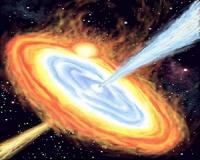 Neutron Stars May Be Too Weak To Power Some Gamma-Ray Bursts
Berkeley CA (SPX) Nov 04, 2010 A gamma-ray burst is an immensely powerful blast of high-energy light thought to be generated by a collapsing star in a distant galaxy, but what this collapse leaves behind has been a matter of debate. A new analysis of four extremely bright bursts observed by NASA's Fermi satellite suggests that the remnant from a long-duration gamma-ray burst is most likely a black hole - not a rapidly s ... read more |
|
|
| The content herein, unless otherwise known to be public domain, are Copyright 1995-2010 - SpaceDaily. AFP and UPI Wire Stories are copyright Agence France-Presse and United Press International. ESA Portal Reports are copyright European Space Agency. All NASA sourced material is public domain. Additional copyrights may apply in whole or part to other bona fide parties. Advertising does not imply endorsement,agreement or approval of any opinions, statements or information provided by SpaceDaily on any Web page published or hosted by SpaceDaily. Privacy Statement |


 del.icio.us
 Digg
Digg Reddit
 YahooMyWeb
 Google
 Facebook


