|
 |
 |
 |
 |
 |
 |
 |
 |
 |

| . |  |
. |
Like Planet Like Sun
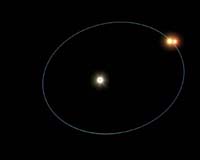
Cote d'Azur, France (SPX) Jun 01, 2006 A team of European astronomers, led by T. Guillot (CNRS, Observatoire de la Cote d'Azur, France), will publish a new study of the physics of Pegasids (also known as hot Jupiters) in Astronomy & Astrophysics. They found that the amount of heavy elements in Pegasids is correlated to the metallicity of their parent stars. This is a first step in understanding the physical nature of the extrasolar planets. Up to now, astronomers have discovered 188 extrasolar planets, among which 10 are known as "transiting planets". These planets pass between their star and us at each orbit. Given the current technical limitations, the only transiting planets that can be detected are giant planets orbiting close to their parent star known as "hot Jupiters" or Pegasids. The ten transiting planets known thus far have masses between 110 and 430 Earth masses (for comparison, Jupiter, with 318 Earth masses, is the most massive planet in our Solar System). Although rare, transiting planets are the key to understanding planetary formation because they are the only ones for which both the mass and radius can be determined. In principle, the obtained mean density can constrain their global composition. However, translating a mean density into a global composition needs accurate models of the internal structure and evolution of planets. The situation is made difficult by our relatively poor knowledge of the behaviour of matter at high pressures (the pressure in the interiors of giant planets is more than a million times the atmospheric pressure on Earth). Of the nine transiting planets known up to April 2006, only the least massive one could have its global composition determined satisfactorily. It was shown to possess a massive core of heavy elements, about 70 times the mass of the Earth, with a 40 Earth-mass envelope of hydrogen and helium. Of the remaining eight planets, six were found to be mostly made up of hydrogen and helium, like Jupiter and Saturn, but their core mass could not be determined. The last two were found to be too large to be explained by simple models. Considering them as an ensemble for the first time, and accounting for the anomalously large planets, Tristan Guillot and his team found that the nine transiting planets have homogeneous properties, with a core mass ranging from 0 (no core, or a small one) up to 100 times the mass of the Earth, and a surrounding envelope of hydrogen and helium. Some of the Pegasids should therefore contain larger amounts of heavy elements than expected. When comparing the mass of heavy elements in the Pegasids to the metallicity of the parent stars, they also found a correlation to exist, with planets born around stars that are as metal-rich as our Sun and that have small cores, while planets orbiting stars that contain two to three times more metals have much larger cores. Their results will be published in Astronomy & Astrophysics. Planet formation models have failed to predict the large amounts of heavy elements found this way in many planets, so these results imply that they need revising. The correlation between stellar and planetary composition has to be confirmed by further discoveries of transiting planets, but this work is a first step in studying the physical nature of extrasolar planets and their formation. It would explain why transiting planets are so hard to find, to start with. Because most Pegasids have relatively large cores, they are smaller than expected and more difficult to detect in transit in front of their stars. In any case, this is very promising for the CNES space mission COROT to be launched in October, which should discover and lead to characterization of tens of transiting planets, including smaller planets and planets orbiting too far from their star to be detected from the ground. What of the tenth transiting planet? XO-1b was announced very recently and is also found to be an anomalously large planet orbiting a star of solar metallicity. Models imply that it has a very small core, so that this new discovery strengthens the proposed stellar-planetary metallicity correlation. Related Links CNRS  Astronomers Catch Planet By Unusual Means
 Baltimore MD (SPX) May 19, 2006
An international team of professional and amateur astronomers, using simple off-the-shelf equipment to trawl the skies for planets outside the solar system, has hauled in their first catch. |
|
|

| The content herein, unless otherwise known to be public domain, are Copyright 1995-2006 - SpaceDaily.AFP and UPI Wire Stories are copyright Agence France-Presse and United Press International. ESA PortalReports are copyright European Space Agency. All NASA sourced material is public domain. Additionalcopyrights may apply in whole or part to other bona fide parties. Advertising does not imply endorsement,agreement or approval of any opinions, statements or information provided by SpaceDaily on any Web page published or hosted by SpaceDaily. Privacy Statement |