|
 |
 |
 |
 |
 |
 |
 |
 |
 |

| . |  |
. |
Long-Lost, Dangerous Asteroid Is Found Again
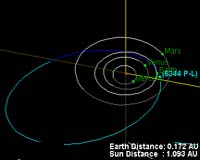
Mountain View CA (SPX) Oct 09, 2007 Echoing the re-discovery of America by the Spanish long after an earlier Viking reconnaissance, astronomers have learned that a recently observed asteroid - one that could potentially hit the Earth - was actually first observed nearly a half-century ago. Researchers at the Minor Planet Center of the Smithsonian Astrophysical Observatory in Cambridge, MA have confirmed work by SETI Institute astronomer Peter Jenniskens that the recently discovered asteroid 2007 RR9 is in fact the long-lost object 6344 P-L. 6344 P-L was last seen in 1960, and ever since has had the peculiar distinction of being the only Potentially Hazardous Asteroid without a formal designation. "The object was long recognized to be dangerous, but we didn't know where it was," says Jenniskens. "Now it is no longer just out there." A designation as Potentially Hazardous means that 2007 RR9 is one of 886 (not 887) known asteroids bigger than 150 m (500 ft) in diameter that come to within 0.05 astronomical units of Earth's orbit (roughly 7,480,000 km or 4,650,000 miles). The size is estimated on the basis of the object's observed brightness and an assumed reflectance of 13 percent. Jenniskens believes that this object may not, in fact, be an asteroid. "This is a now-dormant comet nucleus, a fragment of a bigger object that, after breaking up in the not-so-distant past, may have caused the gamma Piscid shower of slow meteors (IAU #236) that is active in mid-October and early November," he says. 2007 RR9 moves in a 4.70-year orbit, nearly all the way out to the distance of Jupiter. Because of this elongated orbit, it has a Tisserand parameter of T = 2.94, which defines it dynamically as a Jupiter Family Comet (T = 2.0 - 3.0), not an asteroid (T > 3.0). So far, this object has not yet been seen to be even weakly active, but the now dormant comet is still moving closer to the Sun. It is sliding rapidly toward visibility in the southern hemisphere, and is expected to brighten to magnitude +18.5 in mid-October. According to Gareth V. Williams of the Minor Planet Center, it will pass Earth around November 6 at 0.07 AU, when the minor planet is at high latitudes in southern skies. The original designation of P-L stands for "Palomar-Leiden," the juxtaposition of two observatory names that reflect what was a very fruitful collaboration by the trio of pioneer asteroid searchers Tom Gehrels of the University of Arizona, and Ingrid van Houten-Groeneveld and her husband Cornelis Johannes van Houten. Gehrels made a sky survey using the 48-inch Schmidt Telescope at the famed Palomar Observatory, long before modern asteroid reconnaisances, and shipped the photographic plates to the van Houtens at Leiden Observatory in the Netherlands. There, Ingrid discovered 6344 P-L on four plates taken on September 24-28, 1960. The trio are jointly credited with several thousand asteroid discoveries, but only 6344 P-L is a potential danger to Earth. Peter Jenniskens is a meteor astronomer with the SETI Institute and author of "Meteor Showers and their Parent Comets" published by Cambridge University Press (2006). He is also credited with the identification of the parent body of the Quadrantid meteor shower. As it happens, he graduated from Leiden Observatory in 1992, before joining the SETI Institute. Community Email This Article Comment On This Article Related Links SETI Institute Asteroid and Comet Mission News, Science and Technology
 The Threat Of Small Rocks
 Moffet Field CA (SPX) Oct 02, 2007
Every now and then a space rock hits the world's media - sometimes almost literally. Threatening asteroids that zoom past the Earth, fireballs in the sky seen by hundreds of people and mysterious craters which may have been caused by impacting meteorites; all make ESA's planned mission Don Quijote look increasingly timely. Asteroid and comet impacts have played an important role in the history of life on Earth. |
|
|

| The content herein, unless otherwise known to be public domain, are Copyright 1995-2006 - SpaceDaily.AFP and UPI Wire Stories are copyright Agence France-Presse and United Press International. ESA PortalReports are copyright European Space Agency. All NASA sourced material is public domain. Additionalcopyrights may apply in whole or part to other bona fide parties. Advertising does not imply endorsement,agreement or approval of any opinions, statements or information provided by SpaceDaily on any Web page published or hosted by SpaceDaily. Privacy Statement |