
 |
 |
 |
 |
 |
 |
 |
 |
 |
 |

| . |  |
. |
Looking For Extraterrestrial Life In All The Right Places
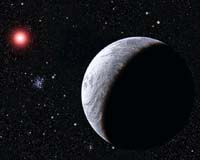
Columbus OH (SPX) Dec 16, 2008 Scientists are expanding the search for extraterrestrial life - and they've set their sights on some very unearthly planets. Cold "Super-Earths" - giant, "snowball" planets that astronomers have spied on the outskirts of faraway solar systems - could potentially support some kind of life, they have found. Such planets are plentiful; experts estimate that one-third of all solar systems contain super-Earths. "We know there are a lot of super-Earths out there, and the next generation of telescopes will be even better at spotting them," said Scott Gaudi, assistant professor of astronomy at Ohio State University. Despite the name, a super-Earth has little in common with the Earth that we know - other than the fact it is has a solid surface. A super-Earth is covered with ice, and may have a substantial atmosphere - perhaps much thicker than the Earth's. Yet Gaudi joined with Eric Gaidos of the University of Hawaii and Sara Seager of the Massachusetts Institute of Technology to model whether such planets might harbor a liquid ocean that could support life, and whether they might be detectable from Earth. Gaidos reported the team's early results at the American Geophysical Union meeting in San Francisco. "It turns out that if super-Earths are young enough, massive enough, or have a thick atmosphere, they could have liquid water under the ice or even on the surface," Gaudi said. "And we will almost certainly be able to detect these habitable planets if they exist." The most promising technique for finding super-Earths is the one Gaudi prefers: gravitational microlensing. When one star happens to cross in front of another as seen from Earth, it magnifies the light from the more distant star like a lens. If planets are orbiting the lens star, they boost the magnification briefly as they pass by. Gaudi and his colleagues first discussed the project this summer at an Aspen Center for Physics workshop. The workshops are sponsored by the National Science Foundation, and they offer an informal atmosphere for scientists to propose new ideas. There, the three talked about using microlensing to search for life in a new way. Most such efforts focus on finding planets in another solar system's "habitable zone" - the distance from a star where temperatures are just right for supporting liquid water on the surface and thus life as we know it. But water is much more plentiful beyond the habitable zone, in the outer reaches of a solar system, Gaudi explained. It's most often found as ice - at the heart of gas planets such as Jupiter, on frozen moons such as Europa, and on super-Earths. In fact, Earth's water probably originated elsewhere, and found its way here on comets or asteroids. So rather than looking for warm planets like Earth that happened to acquire water, Gaudi and his colleagues decided to look at cold super-Earths that formed with water already in place. They examined the likelihood that some internal heat source might enable liquid water to form under the ice. As Gaidos and Seager modeled scenarios for heating the interior of super-Earths, Gaudi modeled whether the planets they hypothesized would be detectable. Gaidos and Seager found that very big super-Earths, ones around 10 times the mass of Earth, could retain enough heat from their formation to form a liquid ocean beneath the ice - even though those planets would be located some five times farther from their star than the Earth is from its sun. Gaudi determined that such planets would be detectable. In fact, microlensing is best at detecting planets that far out in a solar system, he said. As to what type of life might be found there, it's too early to speculate. "A more worrisome question is, if these planets have life on them, how would we know it? We have a hard enough time trying to figure out where there's life on Europa, let alone something that's hundreds of light years away," he added. Share This Article With Planet Earth
Related Links Ohio State University Life Beyond Earth Lands Beyond Beyond - extra solar planets - news and science
 Giving Life A Hand
 Moffett Field CA (SPX) Dec 04, 2008
The basic molecules that make up all living things have a predetermined chirality or "handedness," similar to the way people are right- or left-handed. This chirality has a profound influence on the chemistry and molecular interactions of living organisms. |
|
|

| The content herein, unless otherwise known to be public domain, are Copyright 1995-2007 - SpaceDaily.AFP and UPI Wire Stories are copyright Agence France-Presse and United Press International. ESA Portal Reports are copyright European Space Agency. All NASA sourced material is public domain. Additional copyrights may apply in whole or part to other bona fide parties. Advertising does not imply endorsement,agreement or approval of any opinions, statements or information provided by SpaceDaily on any Web page published or hosted by SpaceDaily. Privacy Statement |
 del.icio.us
 Digg
Digg Reddit
 YahooMyWeb
 Google
 Facebook