
. Military Space News .
BIO FUEL
Making more of methane
by Staff Writers
Thuwal, Saudi Arabia (SPX) Sep 03, 2020

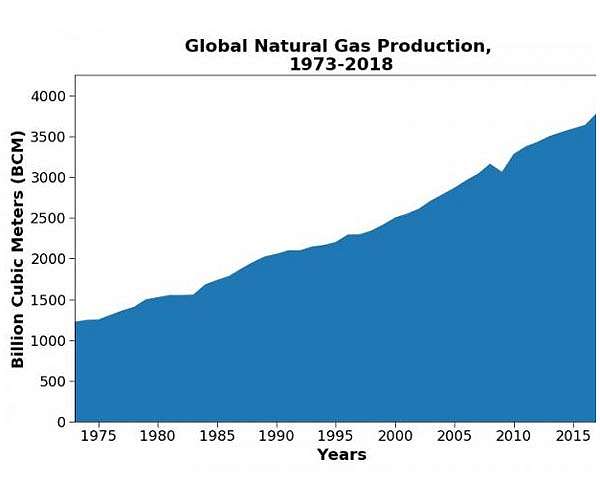
Global natural gas production over years - 2020 data from the International Energy Agency (IEA)

Demand continues for plastics and solvents made from petrochemicals, which are mainly produced by refining oil despite diminishing global oil reserves, driving forward the search for new ways to produce the chemicals we need.

Methane is the main component of natural gas and a promising raw material for the production of industrial chemicals. However, turning methane into commercial products currently requires multiple, energy-intensive stages.

"Finding a more energy efficient direct method would be a real advantage," says Mustafa Calayan, a Ph.D. student working under the supervision of Jorge Gascon, "but a one-step conversion of methane into valuable products is still a great challenge."

The process, methane dehydroaromatization (MDA), requires a catalyst to speed up the reaction, and chemists are searching for the best metal-mineral combination for this vital role. "Understanding the reaction mechanism is crucial for the improvement of a given process," says Calayan.

However, MDA has proven difficult to observe in action. Drawing on their experience with nuclear magnetic resonance (NMR), a technique for visualizing the structure of molecules, Gascon's team studied what happens in the early stages of the reaction using a molybdenum-zeolite catalyst.

The researchers observed the first organic molecules formed by carbon-carbon bonding in the first stages of the reaction. Among these was acetylene, a colorless gas that is widely used as a fuel and chemical building block.

"Finding the right NMR parameters to visualize what we were after was challenging," says co-author Abhishek Dutta Chowdhury, "but we confirmed the existence of some intermediate species that have been hypothesized for a long time."

They also identified two of potentially several activation pathways for carbon-hydrogen bonding that lead to the formation of useful hydrocarbons, such as benzene, a building block of plastics, lubricants, resins and rubber.

"We have found a way to take snapshots at the molecular level of a chemical reaction that occurs under very harsh conditions," says Calayan. Such insights could help enable more efficient methane conversion, with many potential benefits.

For example, natural gas is voluminous and therefore very expensive to transport. "It would be great if we could convert natural gas into condensed hydrocarbons on the extraction site before transporting it," adds Calayan.

One-step methane conversion still has obstacles. "We are working to prevent the catalyst from becoming deactivated too quickly," says Gascon. "This study is one more small step toward making more industrial use of natural gas."

Research paper


Related Links
King Abdullah University Of Science and Technology (KAUST)
Bio Fuel Technology and Application News


Thanks for being here;
We need your help. The Space Media Network continues to grow but revenues have never been harder to maintain.

With the rise of Ad Blockers, and Facebook - our traditional revenue sources via quality network advertising continues to decline. And unlike so many other news sites, we don't have a paywall - with those annoying usernames and passwords.

Our news coverage takes time and effort to publish 365 days a year.

If you find our news sites informative and useful then please consider becoming a regular supporter or for now make a one off contribution.
SpaceMediaNetwork Contributor
$5 Billed Once


credit card or paypal
SpaceMediaNetwork Monthly Supporter
$5 Billed Monthly


paypal only


BIO FUEL
Can sunlight convert emissions into useful materials?
Los Angeles CA (SPX) Sep 02, 2020
Shaama Sharada calls carbon dioxide - the worst offender of global warming - a very stable, "very happy molecule." She aims to change that. Recently published in the Journal of Physical Chemistry A, Sharada and a team of researchers at the USC Viterbi School of Engineering seek to break CO2 apart and convert the greenhouse gas into useful materials like fuels or consumer products ranging from pharmaceuticals to polymers. Typically, this process requires a tremendous amount of energy. H ... read more

Comment using your Disqus, Facebook, Google or Twitter login.


Share this article via these popular social media networks
del.icio.usdel.icio.us DiggDigg RedditReddit GoogleGoogle

BIO FUEL
Advanced Patriot missile fails in live-fire test

Russia testing news S-500 Systems, mass production on the way

Lockheed nets $18.8M to support Japan's Aegis Ashore system

IBCS engages advanced tactical ballistic missile and cruise missile during rigorous test

BIO FUEL
Pentagon slams Chinese missile launches in South China Sea

Indian troops armed with Russian portable SAMs deployed near China border

DARPA's Gremlins Program completes second flight test in demonstration series

Iran unveils missiles with increased range

BIO FUEL
Britain, Belgium to collaborate on MQ-9B drone acquisition

Israel strikes Hamas targets in Gaza over balloon attacks

SqwaQ demonstrates BVLOS UAS flight capabilities for controlled airspace

Turkish drone kills 2 Iraqi officers in Kurdish region: army

BIO FUEL
Airbus to build BADR-8 satellite for Arabsat

U.S. Army readies 'Capability Set '23' for communications modernization

Northrop Grumman to provide key electronic warfare capabilities for AC MC-130J aircraft

South Korea's first military satellite launched

BIO FUEL
Marines to build 100,000-square-foot wargaming center in Virginia

Pentagon policy for immigrant troops violates citizenship law, judge rules

Report: Russia now has 'holistic' approach to warfare

Jacqueline D. Van Ovost becomes only female four-star leader in DoD

BIO FUEL
Pentagon announces $17.4M in contracts under Defense Production Act

UN rejects Iran arms embargo extension, crisis looms

Pompeo cleared over Saudi arms sales: US official

Belgium suspends arms exports to Saudi national guard

BIO FUEL
India, China in new border standoff

Russian Su-27s intercept U.S. B-52s over Black Sea

US warship sails near disputed islands in tense South China Sea

NORAD intercepts three groups of Russian planes near Alaska

BIO FUEL
Scientists open new window into the nanoworld

The smallest motor in the world

Crystalline 'nanobrush' clears way to advanced energy and information tech


The content herein, unless otherwise known to be public domain, are Copyright 1995-2024 - Space Media Network. All websites are published in Australia and are solely subject to Australian law and governed by Fair Use principals for news reporting and research purposes. AFP, UPI and IANS news wire stories are copyright Agence France-Presse, United Press International and Indo-Asia News Service. ESA news reports are copyright European Space Agency. All NASA sourced material is public domain. Additional copyrights may apply in whole or part to other bona fide parties. All articles labeled "by Staff Writers" include reports supplied to Space Media Network by industry news wires, PR agencies, corporate press officers and the like. Such articles are individually curated and edited by Space Media Network staff on the basis of the report's information value to our industry and professional readership. Advertising does not imply endorsement, agreement or approval of any opinions, statements or information provided by Space Media Network on any Web page published or hosted by Space Media Network. General Data Protection Regulation (GDPR) Statement Our advertisers use various cookies and the like to deliver the best ad banner available at one time. All network advertising suppliers have GDPR policies (Legitimate Interest) that conform with EU regulations for data collection. By using our websites you consent to cookie based advertising. If you do not agree with this then you must stop using the websites from May 25, 2018. Privacy Statement. Additional information can be found here at About Us.