
. Military Space News .
Mars, Earth And Moon From Unique Planetary Nursery

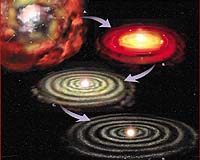
Development of the early solar system.
by Staff Writers
Oxford, UK (SPX) Mar 28, 2008
A study of meteorites suggests that Mars, the Earth and the Moon share a common composition from 'growing up' in a unique planetary nursery in the inner solar system. The finding could lead to a rethink of how the inner solar system formed. The international team of scientists, which includes Professor Alex Halliday from Oxford University's Department of Earth Sciences, report in Nature how they analysed 16 meteorites that fell to Earth from Mars.

They found that the amounts of neodymium-142 these contain are subtly different from those of objects found in the asteroid belt. This isotopic fingerprint is proof that the chemistry of the inner solar system was different even for elements that are hard to vapourise.

Professor Halliday said: "The Earth, Moon and Mars appear to have formed in a part of the inner solar system with a ratio of samarium to neodymium that is around 5 per cent more than could be found in the asteroid belt. It is this 'family resemblance' that we see today when we compare oceanic basalts from Earth with Moon rocks and Martian meteorites.

Such differences may be the result of the erosion of planetary crusts during formation events, alternatively, this composition arose from the sorting of clouds of partially melted droplets or grains - known as 'chondrules'."

Earth has a long geological history of recycling the materials that make up its crust and mantle, which could help explain why its composition is different from that of other planetary bodies - it could, for example, have deeply buried reservoirs of certain elements.

However Mars and the Moon are believed to have been nothing like as active during their lifespan: making it much more difficult for any theory involving material recycling to explain why their composition should differ from other planetary bodies and yet have such similarities with the composition of the Earth.

Professor Halliday said: "What our results suggest is that the sorting of the elements that make up these planets may have happened at a much earlier stage than had been believed.

"It may even be that this sorting happened in the accretion disk out of which Mars and the early Earth first formed. What we can say is that the composition of these worlds is inconsistent with them simply forming out of large 'lumps' of stony meteorites, like those we see today in the asteroid belt."

Community
Email This Article
Comment On This Article

Related Links
University of Oxford
Stellar Chemistry, The Universe And All Within It


Memory Foam Mattress Review
Newsletters :: SpaceDaily :: SpaceWar :: TerraDaily :: Energy Daily
XML Feeds :: Space News :: Earth News :: War News :: Solar Energy News


Solving A Solar System Quandary By Flip-Flopping Uranus And Neptune
Tempe AZ (SPX) Dec 13, 2007
Quick: What's the order of the planets in the solar system? Need a little help? Maybe the following mnemonic rings a bell: "My Very Educated Mother Just Served Up Nine Pizzas." It's useful for remembering the order of the planets today, but it wouldn't have been as useful in the past, and not just because the International Astronomical Union demoted Pluto to "dwarf planet" last year.


  • NATO publishes CFE treaty offer, as Russia summit approaches
  • China the dominant force at Mekong region summit
  • Walker's World: What price NATO?
  • France And UK To Forge Deals On Nuclear And Defence Issues

  • NKorea raises stakes in nuke dispute with missile launches
  • US warns North Korean politics could scuttle nuclear deal
  • NKorea raises stakes in nuke dispute with missile launches
  • NKorea says it may slow disablement of nuke plants

  • US Navy And Raytheon Test Standard Missile 2 Block IIIB
  • Raytheon Awarded Contract for NATO SEASPARROW Surface Missile System
  • Raytheon Awarded Contract for NATO SEASPARROW Surface Missile System
  • India Test Fires Nuclear-Capable Missile

  • Japan completes missile defense system deployment: reports
  • Outside View: ABM talks deadlock -- Part 2
  • Differences remain with Russia on missile defense: US
  • The ABM Deadlock Petrov Version Part One

  • Europe's EADS finds sweet home in Alabama despite uproar
  • A380 superjumbo makes European debut in London
  • Aviation industry must act fast on climate change: Airbus chief
  • Northrop, EADS to invest 600 mln dlrs in Alabama site

  • Elbit To Supply Skylark I UAV To France's Special Forces
  • Boeing Tests Two-Pound Imaging Radar Aboard ScanEagle Unmanned Aircraft
  • Radar Sensor To Be Incorporated Onto Northrop Grumman's MQ-8B Fire Scout
  • Pakistan test-flies pilotless plane: military

  • US Installs Interim Commander In Iraq As Basra Fighting Rages
  • Bush: Iraq must shoulder full cost of security
  • Military Matters: Iraq's new storm
  • US-led coalition forces bomb Shiite militia in Basra

  • US Army Awards GD Contract To Produce Hydra-70 Rockets
  • Fighter Production To Rise Over The Next Decade
  • Boeing Awarded Joint Helmet-Mounted Cueing System Contract
  • F-35C Stealth On The Carrier Deck Means High Performance, Low Maintenance

  • The content herein, unless otherwise known to be public domain, are Copyright 1995-2007 - SpaceDaily.AFP and UPI Wire Stories are copyright Agence France-Presse and United Press International. ESA Portal Reports are copyright European Space Agency. All NASA sourced material is public domain. Additional copyrights may apply in whole or part to other bona fide parties. Advertising does not imply endorsement,agreement or approval of any opinions, statements or information provided by SpaceDaily on any Web page published or hosted by SpaceDaily. Privacy Statement