|
 |
 |
 |
 |
 |
 |
 |
 |
 |

| . |  |
. |
Metal Ring Round White Dwarf Solves Missing Planets Puzzle
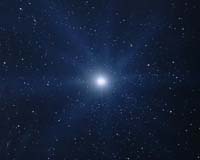
Warwick UK (SPX) Dec 27, 2006 Astrophysicists at the University of Warwick have found an unusual ring of metal-rich gas orbiting very close around a white dwarf star. The presence of the ring helps solve a problem for astronomers who, up till now, have been puzzled by the apparent absence of planets around white dwarf stars. Their research is published today in the Friday December 22nd edition of the journal Science. Click on the picture above for a print quality high resolution artist's impression of the White Dwarf and its ring. The research team led by Dr Boris Gansicke and Professor Tom Marsh from the University of Warwick's Department of Physics found this unusual gas disc around a relatively young white dwarf star called SDSS1228+1040. It is located in the constellation Virgo and it is around 463 light years distant from our solar system. The star became a white dwarf around 100 million years ago, and is still fairly hot with a surface temperature around 22000 degrees. The team observed double-peaked emission lines superimposed on the white dwarf's starlight caused by iron, magnesium and calcium from material in the vicinity of the star. This indicated that they were dealing with a disc of metal-gas orbiting close around the star (around 1.2 solar radii or roughly half a million miles). The observations also show that we are looking nearly edge-on to the ring around the white dwarf. The likely origin of the disc is an asteroid, of at least 50 kilometres in size, which approached close enough to the star to be broken up by tides generated from the gravitational forces of the white dwarf. Those disrupted remains then entered a close orbit around the star and is evaporated by the radiation from the white dwarf. White dwarfs begin as a star similar to our sun (or a star up to 8 times bigger than our sun). Late in the star's life it swells into a red giant probably destroying any inner planets at orbits such as those of Mercury and Venus and pushing out other planets and asteroids to a more distant orbit than before. Here is a link to some simple diagrams explaining this. In the evolution of what is today a white dwarf, the progenitor of SDSS1228+1040 will have destroyed all planetary material out to a distance of 1000 solar radii (roughly 500 million miles), but asteroids still exist today at larger distances. To destabilise an asteroid from an orbit that far out, it needs the gravitational force of a larger object, such as a relatively massive planetesimal, or a genuine planet. While the presence of asteroids around white dwarf has been hypothesized before, the case of SDSS1228+1040 provides the first clear proof of the debris of a planetary disc around a white dwarf, and provides an example of what our own Solar system may look like in around 5 to 8 billion years. This "metal" disc around SDSS1228+1040 appears to be relatively rare. Before their study, three white dwarfs, out of a study of a few hundred, were suggested to be surrounded by planetary debris material. However, in none of those three cases could a definite proof of an asteroid origin be made due to the lack of information on the geometry and the chemical abundance of the material found in the vicinity of these stars. As part of their study, the Warwick team investigated data for 500 additional white dwarfs without finding conclusive evidence for another system harbouring such a disc. The rarity of such a ring made from a disrupted asteroid tells us that the majority of planetary systems may look quite different from our own Solar system. They may not have asteroid belts at all, or not as far out as it is the case in the Solar system, or they may not have planets at such great distances as Mars or Jupiter. This conclusion is consistent with the current knowledge on extrasolar planets found around others stars similar to the Sun, where the vast majority of the exo-planets are in very close orbits around their host stars. Related Links Podcast interview with Dr Gansicke and Professor Marsh Beyond Sol  A Giant Planet Embedded In The Magnetosphere Of Its Star
 Mauna Kea HI (SPX) Nov 28, 2006
Using the ESPaDOnS spectropolarimeter installed on the Canada-France-Hawaii telescope (Mauna Kea, Hawaii), an international team of researchers, led by two French astronomers (C. Catala, LESIA, Observatoire de Paris, and J. F. Donati, LATT, Observatoire Midi-Pyrenees), has just discovered a magnetic field on tau Bootis, a star orbited by a giant planet on a close-in orbit: the first ever detection of this kind! |
|
|

| The content herein, unless otherwise known to be public domain, are Copyright 1995-2006 - SpaceDaily.AFP and UPI Wire Stories are copyright Agence France-Presse and United Press International. ESA PortalReports are copyright European Space Agency. All NASA sourced material is public domain. Additionalcopyrights may apply in whole or part to other bona fide parties. Advertising does not imply endorsement,agreement or approval of any opinions, statements or information provided by SpaceDaily on any Web page published or hosted by SpaceDaily. Privacy Statement |