|
 |
 |
 |
 |
 |
 |
 |
 |
 |

| . |  |
. |
 by Staff Writers West Lafayette IN (SPX) Jan 15, 2016
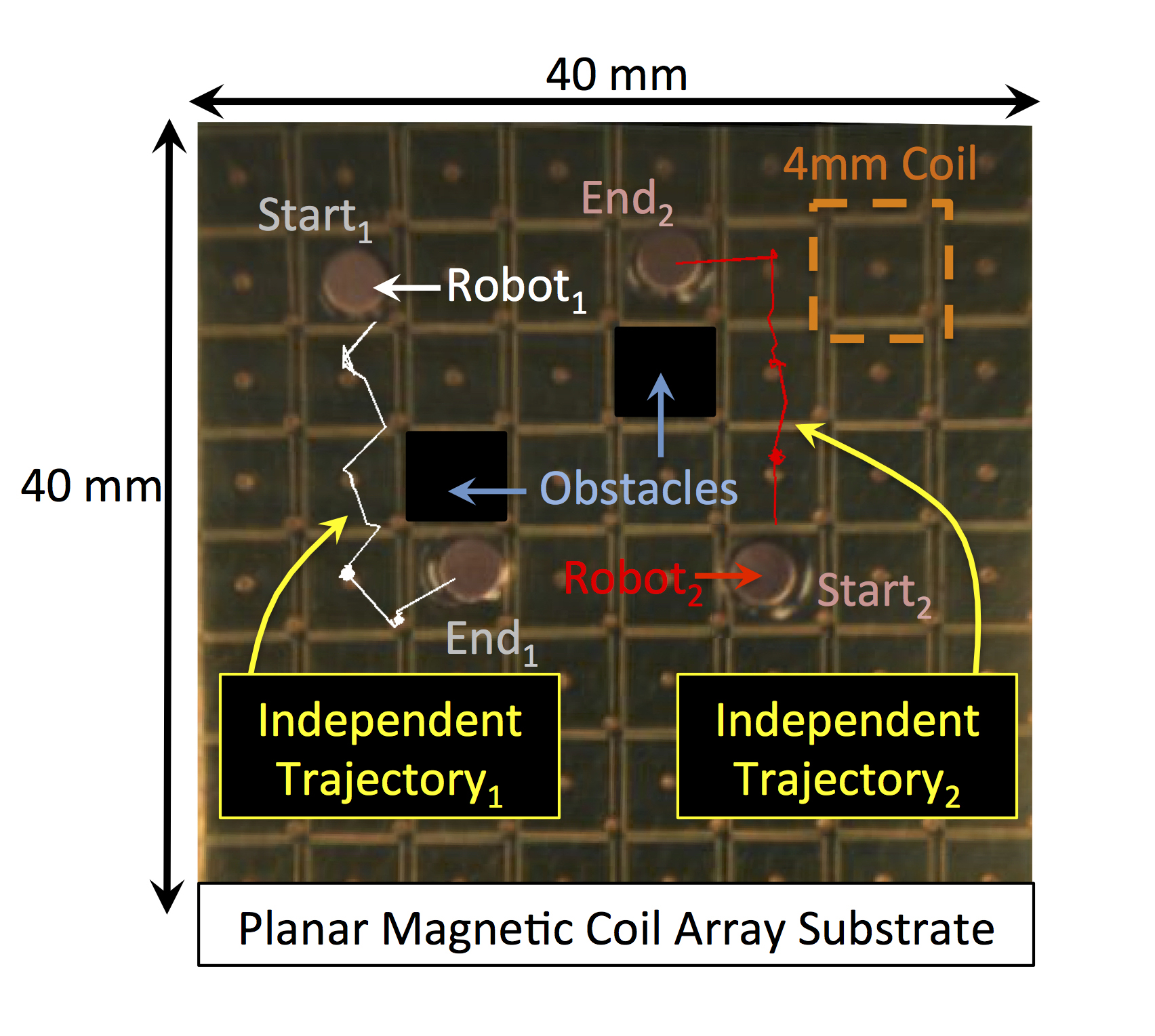
Researchers are using a technology likened to "mini force fields" to independently control individual microrobots operating within groups, an advance aimed at using the tiny machines in areas including manufacturing and medicine. Until now it was only possible to control groups of microbots to move generally in unison, said David Cappelleri, an assistant professor of mechanical engineering at Purdue University. "The reason we want independent movement of each robot is so they can do cooperative manipulation tasks," he said. "Think of ants. They can independently move, yet all work together to perform tasks such as lifting and moving things. We want to be able to control them individually so we can have some robots here doing one thing, and some robots there doing something else at the same time." Findings are detailed in a research paper appearing this month in the journal Micromachines. Postdoctoral research associates Sagar Chowdhury and Wuming Jing, and Cappelleri authored the paper. The team developed a system for controlling the robots with individual magnetic fields from an array of tiny planar coils. "The robots are too small to put batteries on them, so they can't have onboard power," Cappelleri said. "You need to use an external way to power them. We use magnetic fields to generate forces on the robots. It's like using mini force fields." The research is revealing precisely how to control the robots individually. "We need to know, if a robot is here and it needs to go there, how much force needs to be applied to the robot to get it from point A to point B?" Cappelleri said. "Once you figure out what that force has to be, then we say, what kind of magnetic field strength do we need to generate that force?" The microbots are magnetic disks that slide across a surface (shown in this video). While the versions studied are around 2 millimeters in diameter - about twice the size of a pinhead - researches aim to create microbots that are around 250 microns in diameter, or roughly the size of a dust mite. In previously developed systems the microbots were controlled using fewer coils located around the perimeter of the "workspace" containing the tiny machines. However, this "global" field is not fine enough to control individual microrobots independently. "The approach we came up with works at the microscale, and it will be the first one that can give truly independent motion of multiple microrobots in the same workspace because we are able to produce localized fields as opposed to a global field," Cappelleri said. "What we can do now, instead of having these coils all around on the outside, is to print planar coils directly onto the substrate." The robots are moved using attractive or repulsive forces and by varying the strength of the electrical current in the coils. "You can think about using teams of robots to assemble components on a small scale, which we could use for microscale additive manufacturing," Cappelleri said. Independently controlled microbots working in groups might be useful in building microelectromechanical systems, or MEMS, minuscule machines that could have numerous applications from medicine to homeland security. "So far people have been good at making MEMS devices containing different components," he said. "But a lot of times the components are made from different processes and then have to be assembled to make the final device. This is very challenging. We can instead assemble them with our robots. And on the biological side we might use them for cell sorting, cell manipulation, characterization and so on. You could think about putting the microcoils on the bottom of a petri dish." Microbots equipped with probe-like "force sensors" might then be used to detect cancer cells in a biopsy. "Cancer cells have different stiffness characteristics than non-cancer cells, and in some of our previous work we put force sensors on the end of these robots to figure out which ones are stiffer than others," Cappelleri said. The coils were made by printing a copper pattern with the same technology used to manufacture printed circuit boards. They can be scaled down from their current size of about 4 millimeters. A new process, however, was needed to create a microscale prototype, he said. The research is ongoing. The team will attempt to use microscale prototypes to assemble components for MEMS devices. One potential obstacle is the effect of van der Waals forces between molecules that are present on the scale of microns but not on the macroscale of everyday life. The forces might cause "stiction" between tiny components that affect their operation. Towards Independent Control of Multiple Magnetic Mobile Microrobots; Sagar Chowdhury, Wuming Jing and David J. Cappelleri - School of Mechanical Engineering, Purdue University.
Related Links Purdue University All about the robots on Earth and beyond!
|
|||||||||||||
|
|
| The content herein, unless otherwise known to be public domain, are Copyright 1995-2024 - Space Media Network. All websites are published in Australia and are solely subject to Australian law and governed by Fair Use principals for news reporting and research purposes. AFP, UPI and IANS news wire stories are copyright Agence France-Presse, United Press International and Indo-Asia News Service. ESA news reports are copyright European Space Agency. All NASA sourced material is public domain. Additional copyrights may apply in whole or part to other bona fide parties. All articles labeled "by Staff Writers" include reports supplied to Space Media Network by industry news wires, PR agencies, corporate press officers and the like. Such articles are individually curated and edited by Space Media Network staff on the basis of the report's information value to our industry and professional readership. Advertising does not imply endorsement, agreement or approval of any opinions, statements or information provided by Space Media Network on any Web page published or hosted by Space Media Network. General Data Protection Regulation (GDPR) Statement Our advertisers use various cookies and the like to deliver the best ad banner available at one time. All network advertising suppliers have GDPR policies (Legitimate Interest) that conform with EU regulations for data collection. By using our websites you consent to cookie based advertising. If you do not agree with this then you must stop using the websites from May 25, 2018. Privacy Statement. Additional information can be found here at About Us. |


 del.icio.us
 Digg
Digg Reddit
 Google