|
 |
 |
 |
 |
 |
 |
 |
 |
 |

| . |  |
. |
NASA Comet Dust Lands In Manchester
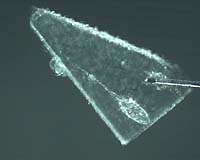
Manchester, UK (SPX) Feb 08, 2008 Scientists in Manchester have received small fragments of material from the Wild 2 comet (pronounced 'Vilt 2' after the Swiss astronomer who discovered it), which was brought back to earth by NASA's Stardust space mission. The Cosmochemistry research group, within the School of Earth, Atmospheric and Environmental Sciences (SEAES), is now analysing the material using two state of the art mass spectrometers. The Interstellar Dust Laser Explorer (IDLE) will be used to profile the chemical make-up of the dust particles. It uses beams of ions to create magnified images of materials at a molecular level. The Refrigerator Enhanced Laser Analysis for Xenon (RELAX) machine will be used to detect the presence of xenon. This is achieved by firing powerful lasers at the samples and actually destroying them in order to extract the information required. The Manchester scientists say the research is an exciting prospect, as they will be analysing xenon that has been kept in 'cold storage' since the solar system was born. Unlike other comets, Wild 2 has only recently come close to the sun, meaning it has not been heated and remains in relatively pristine condition. This is one of the reasons scientists chose it as the target of the Stardust space mission. It's hoped that analysing the xenon found in the comet fragments will give scientists a window into the distant past and help them unravel mysteries surrounding the birth and evolution of our solar system. The samples that have arrived in Manchester are embedded in highly porous sponge-like material called aerogel, which was used to collect small fragments spewing from the Wild 2 comet. As the particles embedded themselves into the aerogel, travelling at around 6km per second, they slowed down and created what are known as 'tracks'. Manchester has received a cross section of a carrot-shaped track containing embedded comet particles. The samples are prepared in a special clean zoom before being zapped with lasers and analysed. The University of Manchester, as part of a UK consortium, was chosen by NASA to receive the samples due to the fact that IDLE and RELAX are the only machines of their type capable of performing certain crucial analyses of the comet fragments. Both machines have been developed by scientists at the University. Dr Jamie Gilmour, a scientist working on the RELAX project, said: "We are extremely excited to have received the material from NASA. We hope these samples will give us a snapshot of what the solar system was like when it started to form more than 4.5 billion years ago." Manchester has five scientists working on the three-year project funded by the Science and Technologies Facilities Council (STFC). The UK Stardust consortium is led by The University of Leicester and also includes The Open University, The University of Kent, Imperial College London and the Natural History Museum. Samples from the comet were given to the UK group based on the fact each institution has different expertise and the facilities for different analytical techniques. The Stardust mission was launched into space in early February 1999 and encountered Comet Wild 2 in 2004, while nearly 242 million miles from earth. The NASA mission returned particles captured from the comet in 2006 - the first grains of cometary dust ever returned to earth. A comet is a small, icy celestial body that orbits around the sun. It is made up of a nucleus (solid, frozen ice, gas and dust), a gaseous coma (water vapour, carbon dioxide and other gases) and a long tail (made of dust and ionized gases). Community Email This Article Comment On This Article Related Links Science and Technologies Facilities Council Asteroid and Comet Mission News, Science and Technology
 Stardust Comet Dust Resembles Asteroid Materials
 Livermore CA (SPX) Jan 25, 2008
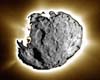
Contrary to expectations for a small icy body, much of the comet dust returned by the Stardust mission formed very close to the young sun and was altered from the solar system's early materials. When the Stardust mission returned to Earth with samples from the comet Wild 2 in 2006, scientists knew the material would provide new clues about the formation of our solar system, but they didn't know exactly how. |
|
|

| The content herein, unless otherwise known to be public domain, are Copyright 1995-2007 - SpaceDaily.AFP and UPI Wire Stories are copyright Agence France-Presse and United Press International. ESA Portal Reports are copyright European Space Agency. All NASA sourced material is public domain. Additional copyrights may apply in whole or part to other bona fide parties. Advertising does not imply endorsement,agreement or approval of any opinions, statements or information provided by SpaceDaily on any Web page published or hosted by SpaceDaily. Privacy Statement |