|
 |
 |
 |
 |
 |
 |
 |
 |
 |

| . |  |
. |
NASA Researchers Discover Planet With Largest Solid Core
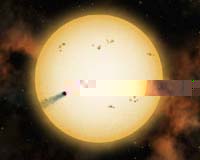
Tokyo, Japan (SPX) Jul 01, 2005 NASA researchers recently discovered the largest solid core ever found in an extrasolar planet, and their discovery confirms a planet formation theory. "For theorists, the discovery of a planet with such a large core is as important as the discovery of the first extrasolar planet around the star 51 Pegasi in 1995," said Shigeru Ida, theorist from the Tokyo Institute of Technology, Japan. When a consortium of American, Japanese and Chilean astronomers first looked at this planet, they expected one similar to Jupiter. "None of our models predicted that nature could make a planet like the one we are studying," said Bun'ei Sato, consortium member and postdoctoral fellow at Okayama Astrophysical Observatory, Japan. Scientists have rarely had opportunities like this to collect such solid evidence about planet formation. More than 150 extrasolar planets have been discovered by observing changes in the speed of a star, as it moves toward and away from Earth. The changes in speed are caused by the gravitational pull of planets. This planet also passes in front of its star and dims the starlight. "When that happens, we are able to calculate the physical size of the planet, whether it has a solid core, and even what its atmosphere is like," said Debra Fischer. She is consortium team leader and professor of astronomy at San Francisco State University, Calif. The planet, orbiting the sun-like star HD 149026, is roughly equal in mass to Saturn, but it is significantly smaller in diameter. It takes just 2.87 days to circle its star, and the upper atmosphere temperature is approximately 2,000 degrees Fahrenheit. Modeling of the planet's structure shows it has a solid core approximately 70 times Earth's mass. This is the first observational evidence that proves the "core accretion" theory about how planets are formed. Scientists have two competing but viable theories about planet formation. In the "gravitational instability" theory, planets form during a rapid collapse of a dense cloud. With the "core accretion" theory, planets start as small rock-ice cores that grow as they gravitationally acquire additional mass. Scientists believe the large, rocky core of this planet could not have formed by cloud collapse. They think it must have grown a core first, and then acquired gas. "This is a confirmation of the core accretion theory for planet formation and evidence that planets of this kind should exist in abundance," said Greg Henry, an astronomer at Tennessee State University, Nashville. He detected the dimming of the star by the planet with his robotic telescopes at Fairborn Observatory in Mount Hopkins, Arizona. Support for this research came from NASA, the National Astronomical Observatory of Japan and the National Science Foundation. A paper about this discovery was accepted for publication in the Astrophysical Journal. The paper, supporting materials and illustrations are available on the Internet at: Related Links N2K Consortium SpaceDaily Search SpaceDaily Subscribe To SpaceDaily Express  Detour: Planetary Construction Zone Ahead
 Cambridge MA (SPX) Jun 27, 2005
Interstellar travelers might want to detour around the star system TW Hydrae to avoid a messy planetary construction site. |
|
|

| The content herein, unless otherwise known to be public domain, are Copyright 1995-2006 - SpaceDaily.AFP and UPI Wire Stories are copyright Agence France-Presse and United Press International. ESA PortalReports are copyright European Space Agency. All NASA sourced material is public domain. Additionalcopyrights may apply in whole or part to other bona fide parties. Advertising does not imply endorsement,agreement or approval of any opinions, statements or information provided by SpaceDaily on any Web page published or hosted by SpaceDaily. Privacy Statement |