. Military Space News .
NASA Sends Spacecraft On Mission To Comet Hartley 2

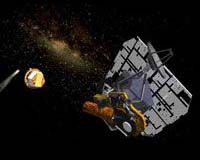
This is an artist's rendition of the Deep Impact flyby spacecraft releasing its impactor, 24 hours before the impact event in July 2005. Pictured from left to right are comet Tempel 1, the impactor, and the flyby spacecraft. The impactor is a 370-kilogram mass with an onboard guidance system. The flyby spacecraft includes a solar panel (right), a high-gain antenna (top), a debris shield (left, background), and science instruments for high and medium resolution imaging, infrared spectroscopy, and optical navigation (yellow box and cylinder, lower left). The fly spacecraft is about 3.2 meters long, 1.7 meters wide, and 2.3 meters high. The launch payload has a mass of 1020 kilograms. The flyby spacecraft is being re-christened as EPOXI. Credit: NASA/JPL
by Staff Writers
Greenbelt MD (SPX) Dec 17, 2007
NASA has approved the retargeting of the Epoxi mission for a flyby of comet Hartley 2 on Oct. 11, 2010. Hartley 2 was chosen as Epoxi's destination after the initial target, comet Boethin, could not be found. Scientists theorize comet Boethin may have broken up into pieces too small for detection.

The Epoxi mission melds two compelling science investigations -- the Extrasolar Planet Observation and Characterization and the Deep Impact Extended Investigation. Both investigations will be performed using the Deep Impact spacecraft.

In addition to investigating comet Hartley 2, the spacecraft will point the larger of its two telescopes at nearby previously discovered extrasolar planetary systems in late January 2008. It will study the physical properties of giant planets and search for rings, moons and planets as small as three Earth masses. It also will look at Earth as though it were an extrasolar planet to provide data that could become the standard for characterizing these types of planets.

"The search for exosolar planetary systems is one of the most intriguing explorations of our time," said Drake Deming, Epoxi deputy principal investigator at NASA's Goddard Space Flight Center, Greenbelt, Md. "With Epoxi we have the potential to discover new worlds and even analyze the light they emit to perhaps discover what atmospheres they possess."

The mission's closest approach to the small half-mile-wide comet will be about nearly a thousand kilometers (620 miles). The spacecraft will employ the same suite of two science instruments the Deep Impact spacecraft used during its prime mission to guide an impactor into comet Tempel 1 in July 2005.

If Epoxi's observations of Hartley 2 show it is similar to one of the other comets that have been observed, this new class of comets will be defined for the first time. If the comet displays different characteristics, it would deepen the mystery of cometary diversity.

"When comet Boethin could not be located, we went to our backup, which is every bit as interesting but about two years farther down the road," said Tom Duxbury, Epoxi project manager at NASA's Jet Propulsion Laboratory in Pasadena, Calif.

Mission controllers at JPL began directing Epoxi towards Hartley 2 on Nov. 1. They commanded the spacecraft to perform a three-minute rocket burn that changed the spacecraft's velocity. Epoxi's new trajectory sets the stage for three Earth flybys, the first on Dec. 31, 2007. This places the spacecraft into an orbital "holding pattern" until it's time for the optimal encounter of comet Hartley 2 in 2010.

"Hartley 2 is scientifically just as interesting as comet Boethin because both have relatively small, active nuclei," said Michael A'Hearn, principal investigator for Epoxi at the University of Maryland, College Park.

Epoxi's low mission cost of $40 million is achieved by taking advantage of the existing Deep Impact spacecraft.
Community
Email This Article
Comment On This Article

Related Links
Epoxi
Asteroid and Comet Mission News, Science and Technology


Memory Foam Mattress Review
Newsletters :: SpaceDaily :: SpaceWar :: TerraDaily :: Energy Daily
XML Feeds :: Space News :: Earth News :: War News :: Solar Energy News


NASA Sends Spacecraft On Mission To Comet Hartley 2
Pasadena CA (SPX) Dec 14, 2007
NASA has approved the retargeting of the Epoxi mission for a flyby of comet Hartley 2 on Oct. 11, 2010. Hartley 2 was chosen as Epoxi's destination after the initial target, comet Boethin, could not be found. Scientists theorize comet Boethin may have broken up into pieces too small for detection.


  • Russian army chief accuses West over arms control
  • Russian arms treaty suspension 'unjustified': Britain
  • US 'deeply regrets' Russia's 'wrong' decision on CFE
  • Political power and economic wealth go together in China: researcher

  • Israeli team in US to counter new Iran assessment: press
  • US missile could trigger Russian strike: Russian army chief
  • US wants nuclear-free Middle East, but on conditions
  • Two Koreas in shoving match over disputed border

  • India tests surface-to-air missile: defence ministry
  • India successfully tests surface-to-air Akash missile
  • Spanish Government Signed Acquisition Contract For Spike-ER Missiles
  • Lockheed Martin-built Trident II D5 Missile Achieves Record 120 Successful Test Launches In A Row

  • Czech govt calls Russian missile warning 'unimaginable': report
  • Japan to conduct missile interceptor test next week: official
  • BMD Focus: Polish base and Hill deal
  • Missile shield needed despite Iran intel report: US official

  • Airbus close to sale of four factories: report
  • California urges regulation on aircraft emissions
  • Announcement Of Opportunity For Sounding Rocket And Balloon Flights
  • China to order up to 150 Airbus jets during Sarkozy visit: report

  • EuroControl Outlines Specifications For Use Of UAVs In European Airspace
  • Flying Fish Unmanned Aircraft Takes Off And Lands On Water
  • Teal Predicts UAV Market Will Reach Nearly 55 Billion Dollars Over Next Decade
  • AFRL And Boeing Demonstrate That UAVs Can Perform Automated Aerial Refueling

  • Iraq Tribal Alliances Pay Off
  • Feature: Looking for IEDs
  • Military Matters: Insurgency patterns
  • Gates warns of Iran threat to US and Mideast

  • EDO Receives Order For Crew 2.1 Counter-IED Systems
  • Army Looks At Long-Term Need For Mine-Resistant Vehicles
  • F-22s At Langley Receive FOC Status
  • BAE Systems Completes First Test Of Autonomous Landing System

  • The content herein, unless otherwise known to be public domain, are Copyright 1995-2006 - SpaceDaily.AFP and UPI Wire Stories are copyright Agence France-Presse and United Press International. ESA PortalReports are copyright European Space Agency. All NASA sourced material is public domain. Additionalcopyrights may apply in whole or part to other bona fide parties. Advertising does not imply endorsement,agreement or approval of any opinions, statements or information provided by SpaceDaily on any Web page published or hosted by SpaceDaily. Privacy Statement