
 |
 |
 |
 |
 |
 |
 |
 |
 |
 |

| . |  |
. |
NASA Spacecraft Show Three-Dimensional Anatomy Of A Solar Storm
Greenbelt, MD (SPX) Apr 17, 2009 Twin NASA spacecraft have provided scientists with their first view of the speed, trajectory, and three-dimensional shape of powerful explosions from the Sun known as coronal mass ejections, or CMEs. This new capability will dramatically enhance scientists' ability to predict if and how these solar tsunamis could affect Earth. When directed toward our planet, these ejections can be breathtakingly beautiful and yet potentially cause damaging effects worldwide. The brightly colored phenomena known as auroras - more commonly called Northern or Southern Lights - are examples of Earth's upper atmosphere harmlessly being disturbed by a CME. However, ejections can produce a form of solar cosmic rays that can be hazardous to spacecraft, astronauts and technology on Earth. Space weather produces disturbances in electromagnetic fields on Earth that can induce extreme currents in wires, disrupting power lines and causing wide-spread blackouts. These Sun storms can interfere with communications between ground controllers and satellites and with airplane pilots flying near Earth's poles. Radio noise from the storm also can disrupt cell phone service. Space weather has been recognized as causing problems with new technology since the invention of the telegraph in the 19th century. NASA's twin Solar Terrestrial Relations Observatory, or STEREO, spacecraft are providing the unique scientific tool to study these ejections as never before. Launched in October 2006, STEREO's nearly identical observatories can make simultaneous observations of these ejections of plasma and magnetic energy that originate from the Sun's outer atmosphere, or corona. The spacecraft are stationed at different vantage points. One leads Earth in its orbit around the Sun, while the other trails the planet. Using three-dimensional observations, solar physicists can examine a CME's structure, velocity, mass, and direction in the corona while tracking it through interplanetary space. These measurements can help determine when a CME will reach Earth and predict how much energy it will deliver to our magnetosphere, which is Earth's protective magnetic shield. "Before this unique mission, measurements and the subsequent data of a CME observed near the Sun had to wait until the ejections arrived at Earth three to seven days later," said Angelos Vourlidas, a solar physicist at the Naval Research Laboratory in Washington. Vourlidas is a project scientist for the Sun Earth Connection Coronal and Heliospheric Investigation, STEREO's key science instrument suite. "Now we can see a CME from the time it leaves the solar surface until it reaches Earth, and we can reconstruct the event in 3D directly from the images." These ejections carry billions of tons of plasma into space at thousands of miles per hour. This plasma, which carries with it some of the magnetic field from the corona, can create a large, moving disturbance in space that produces a shock wave. The wave can accelerate some of the surrounding particles to high energies that can produce a form of solar cosmic rays. This process also can create disruptive space weather during and following the CME's interaction with Earth's magnetosphere and upper atmosphere. "The new vantage point of these spacecraft has revolutionized the study of solar physics," said Madhulika Guhathakurta, STEREO program scientist at NASA Headquarters in Washington. "We can better determine the impact of CME effects on Earth because of our new ability to observe in 3D." STEREO is part of NASA's Solar Terrestrial Probes Program in NASA's Science Mission Directorate in Washington. The program seeks to understand the fundamental physical processes of the space environment from the Sun to Earth and other planets. The Solar Terrestrial Probes Program also seeks to understand how society, technological systems and the habitability of planets are affected by solar processes. This information may lead to a better ability to predict extreme and dynamic conditions in space, and the development of new technologies to increase safety and productivity of human and robotic space exploration. Share This Article With Planet Earth
Related Links STEREO Solar Science News at SpaceDaily
 Breakthrough In Stereo Mission Could Help Prevent Satellite Damage
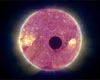 Greenbelt, MD (SPX) Apr 16, 2009
Scientists working on NASA's twin STEREO spacecraft have made a significant breakthrough that could play a major role in protecting satellites from the damage caused by solar explosions, known as Coronal Mass Ejections (CMEs). |
|
|

| The content herein, unless otherwise known to be public domain, are Copyright 1995-2007 - SpaceDaily.AFP and UPI Wire Stories are copyright Agence France-Presse and United Press International. ESA Portal Reports are copyright European Space Agency. All NASA sourced material is public domain. Additional copyrights may apply in whole or part to other bona fide parties. Advertising does not imply endorsement,agreement or approval of any opinions, statements or information provided by SpaceDaily on any Web page published or hosted by SpaceDaily. Privacy Statement |
 del.icio.us
 Digg
Digg Reddit
 YahooMyWeb
 Google
 Facebook