
 |
 |
 |
 |
 |
 |
 |
 |
 |
 |

| . |  |
. |
NASA Supercomputer Shows How Dust Rings Point To Exo-Earths
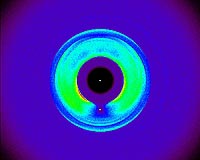
Greenbelt MD (SPX) Oct 13, 2008 Supercomputer simulations of dusty disks around sunlike stars show that planets nearly as small as Mars can create patterns that future telescopes may be able to detect. The research points to a new avenue in the search for habitable planets. "It may be a while before we can directly image earthlike planets around other stars but, before then, we'll be able to detect the ornate and beautiful rings they carve in interplanetary dust," says Christopher Stark, the study's lead researcher at the University of Maryland, College Park. Working with Marc Kuchner at NASA's Goddard Space Flight Center in Greenbelt, Md., Stark modeled how 25,000 dust particles responded to the presence of a single planet - ranging from the mass of Mars to five times Earth's - orbiting a sunlike star. Using NASA's Thunderhead supercomputer at Goddard, the scientists ran 120 different simulations that varied the size of the dust particles and the planet's mass and orbital distance. "Our models use ten times as many particles as previous simulations. This allows us to study the contrast and shapes of ring structures," Kuchner adds. From this data, the researchers mapped the density, brightness, and heat signature resulting from each set of parameters. "It isn't widely appreciated that planetary systems - including our own - contain lots of dust," Stark adds. "We're going to put that dust to work for us." Much of the dust in our solar system forms inward of Jupiter's orbit, as comets crumble near the sun and asteroids of all sizes collide. The dust reflects sunlight and sometimes can be seen as a wedge-shaped sky glow - called the zodiacal light - before sunrise or after sunset. The computer models account for the dust's response to gravity and other forces, including the star's light. Starlight exerts a slight drag on small particles that makes them lose orbital energy and drift closer to the star. "The particles spiral inward and then become temporarily trapped in resonances with the planet," Kuchner explains. A resonance occurs whenever a particle's orbital period is a small-number ratio - such as two-thirds or five-sixths - of the planet's. For example, if a dust particle makes three orbits around its star every time the planet completes one, the particle repeatedly will feel an extra gravitational tug at the same point in its orbit. For a time, this extra nudge can offset the drag force from starlight and the dust can settle into subtle ring-like structures. "The particles spiral in toward the star, get trapped in one resonance, fall out of it, spiral in some more, become trapped in another resonance, and so on," Kuchner says. Accounting for the complex interplay of forces on tens of thousands of particles required the mathematical horsepower of a supercomputer. Some scientists note that the presence of large amounts of dust could present an obstacle to directly imaging earthlike planets. Future space missions - such as NASA's James Webb Space Telescope, now under construction and scheduled for launch in 2013, and the proposed Terrestrial Planet Finder - will study nearby stars with dusty disks. The models created by Stark and Kuchner give astronomers a preview of dust structures that signal the presence of otherwise hidden worlds. "Our catalog will help others infer a planet's mass and orbital distance, as well as the dominant particle sizes in the rings," Stark says. Stark and Kuchner published their results in the October 10 issue of The Astrophysical Journal. Stark has made his atlas of exo-zodiacal dust simulations available online. Community Email This Article Comment On This Article Share This Article With Planet Earth
Related Links The Exozodi Simulation Catalog Lands Beyond Beyond - extra solar planets - news and science Life Beyond Earth
 A Strategy For Detecting Earth-Like Planets
 Washington DC (SPX) Oct 13, 2008
The Exoplanet Task Force of the Astronomy and Astrophysics Advisory Committee has released its report detailing a strategy for obtaining the first detection and characterization of Earth-like planets around other stars within a time frame as short as 15 years. |
|
|

| The content herein, unless otherwise known to be public domain, are Copyright 1995-2007 - SpaceDaily.AFP and UPI Wire Stories are copyright Agence France-Presse and United Press International. ESA Portal Reports are copyright European Space Agency. All NASA sourced material is public domain. Additional copyrights may apply in whole or part to other bona fide parties. Advertising does not imply endorsement,agreement or approval of any opinions, statements or information provided by SpaceDaily on any Web page published or hosted by SpaceDaily. Privacy Statement |
 del.icio.us
 Digg
Digg Reddit
 YahooMyWeb
 Google
 Facebook